

Nov. 06, 2026

19 Min read

Investments

Share :


A Unit Linked Insurance Plan, usually called a ULIP, combines life insurance and market-linked investing into a single policy, and this guide explains in simple words what that means, how the money moves inside the plan, what the ULIP benefits are and what they cost, so that you can decide whether it deserves a place in your plan for long-term goals such as your child’s education, a home or retirement.
It covers the ULIP meaning, how a ULIP works, the fund choices, the lock-in period, the charges, the returns you can reasonably expect, the maturity benefits, the tax rules as they stand in 2026, and a side-by-side look at ULIP vs mutual fund, along with a step-by-step view of how you can explore and buy a ULIP through Finkeda. It is written for first-time investors and does not assume any background in insurance or markets.
What it is: A ULIP is a life insurance policy where part of your premium pays for life cover and the rest is invested in funds of your choice, so the value of your investment moves with the market.
Best suited to: Goals that are at least 10 to 15 years away, for people who are comfortable with market ups and downs and can continue paying premiums for the full term.
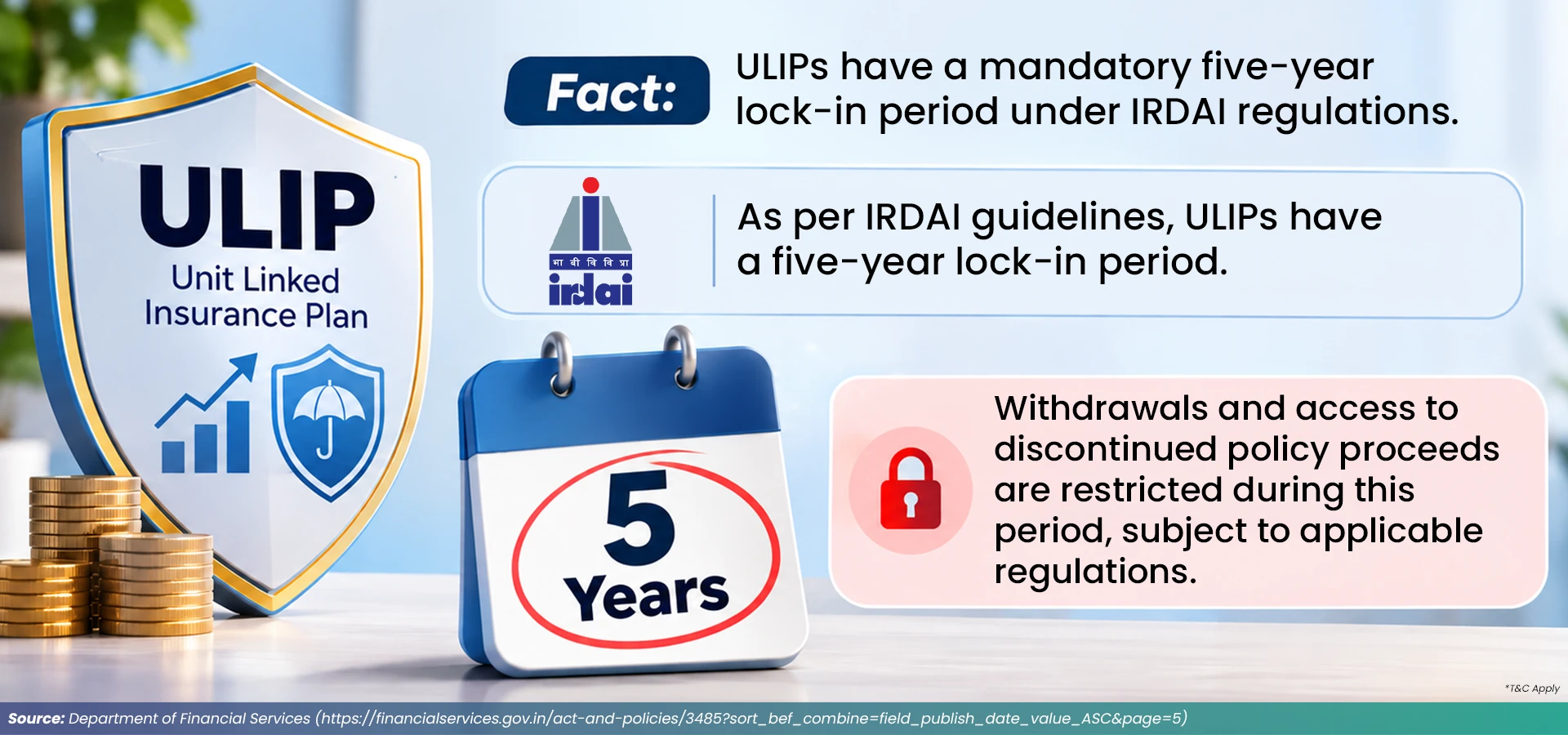
Lock-in: Five years. You cannot withdraw or surrender the money fully or partly during this period, and partial withdrawals are usually possible only after it ends.
Charges: Premium allocation, fund management (capped at 1.35% a year), policy administration and mortality charges all reduce the fund value, and they are highest in the early years.
Tax (2026): Maturity proceeds are exempt when the total annual premium of your ULIPs is ₹2.5 lakh or less; the premium deduction under Section 80C is available only under the old tax regime, and higher premiums are taxed as capital gains.
Returns: Market-linked and not guaranteed, so the fund value can be lower than the premiums paid, especially if you exit early.
Through Finkeda: You can compare ULIPs from insurers and buy one with help from the Finkeda team. The policy is issued and managed by the insurer, and Finkeda is not the insurer.
Ritika is 30, works at a software company in Pune and can put away about ₹8,000 every month. She has two goals that are both a long way off: a down payment for a house in about twelve years and a retirement fund that she will need in about twenty-five. Her father says fixed deposits are the only safe option, a colleague swears by mutual funds, and an insurance agent who called her last week said that a ULIP could do both jobs at once, so by the end of the week she had three opinions and no decision.
This guide is written for people in Ritika’s position. It explains what a ULIP is in plain language, shows how your money moves inside it, and puts the benefits and the costs next to each other, because a plan that sounds attractive on a phone call still has to be judged on what it charges, how long it holds your money and how much risk you are ready to carry.
Short answer: a ULIP makes sense when your goal is at least 10 to 15 years away, when you want life cover and market-linked investing in one policy, when you can live with the ups and downs of the market, and when you are sure you can keep paying premiums for the whole term. It does not make sense for money you may need within five years, and it is not a way to earn assured returns.
The full form of ULIP is Unit Linked Insurance Plan, and the easiest way to understand it is to break the name into its two halves. The insurance half means that the plan gives you life cover, so if the policyholder passes away during the term, the family receives a payout. The unit-linked half means that the money you invest is turned into units of a fund, much like units of a mutual fund, and the value of those units goes up and down with the market.
So when people ask what a ULIP is, the short answer is that it is a life insurance policy that also works as an investment. A part of every premium goes towards the life cover and the charges, and the rest is invested in the fund or funds you pick, which is why a ULIP is often described as a plan with a dual purpose.
It is also worth saying what a ULIP is not. An ULIP investment is not a fixed deposit, and it is not a plan with assured returns, because the investment risk in a ULIP is carried by the policyholder, and the final amount you receive depends on how the chosen funds perform over the years.
People often ask how ULIP works in practice, and it becomes much easier to understand once you follow one premium through the plan, which is what the table below does:
| # | Stage | What happens? |
| 1 | You pay the premium. | You pay a fixed premium every year (or every month) for the premium payment term you chose, or a single premium in some plans. |
| 2 | Charges are deducted. | The insurer takes a premium allocation charge first and later deducts other charges, such as the mortality charge for your life cover and a small administration charge, by cancelling some units. |
| 3 | The rest is invested. | The remaining amount is invested in the fund or funds you selected, and you receive units at that day’s Net Asset Value (NAV). |
| 4 | The fund value changes. | The NAV moves every day with the market, so the value of your units rises and falls, and the fund management charge is already built into the NAV. |
| 5 | You can switch or top up. | You can move money between funds and, in most plans, add extra amounts as top-ups when you have surplus funds. |
| 6 | The policy ends. | At maturity you receive the fund value, and if the policyholder dies during the term, the nominee receives the death benefit. |
Here is a small example with made-up numbers, only to show the mechanics. Suppose you pay a premium of ₹50,000 and the plan takes a premium allocation charge of 3%, which is ₹1,500, so ₹48,500 is invested. If the NAV of your chosen fund is ₹25 that day, you receive 1,940 units, and from then on the value of your investment depends on the NAV:
| NAV later | Units held | Value of units (before other charges) |
| ₹22.00 | 1,940 | ₹42,680 |
| ₹25.00 | 1,940 | ₹48,500 |
| ₹27.50 | 1,940 | ₹53,350 |
The number of units stays the same, and only the NAV changes, which is why the value can go below what you paid in a bad year and above it in a good one.
Fund Options Inside a ULIP
Most ULIPs let you choose from a few kinds of funds, and this choice decides most of the risk you take. The three broad types are these:
| Fund type | Where the money goes | Risk level | Usually suits |
| Equity funds | Shares of large-, mid- and small-cap companies. | Higher, with bigger ups and downs. | Long horizons of 10 years or more. |
| Debt funds | Government securities, bonds and similar instruments. | Lower, with steadier movement. | Cautious investors or shorter horizons. |
| Balanced or hybrid funds | A mix of equity and debt. | Moderate. | Investors who want growth with some cushion. |
A common approach for long-term goals is to hold more equity when the goal is far away and to move gradually towards debt as the goal comes closer, and since ULIPs allow switching between funds, this can be done without buying a new policy, although the insurer may allow only a limited number of free switches every year.
The real benefits of a ULIP come from a handful of features, and it helps to judge each of them honestly and not just by how they sound in a brochure.
With a ULIP you get protection for your family and a market-linked investment under one policy and one premium, which some people find easier to manage than two separate products, although it is fair to say that a pure term plan usually gives you more cover for a lower premium if cover is your main need.
Because there is a five-year lock-in and premiums are paid on a schedule, A ULIP has a five-year lock-in period, which may encourage a long-term investment approach. However, investment outcomes depend on market performance, fund selection and other factors, and staying invested does not guarantee returns.
You can move your money between equity, debt and balanced funds as your goals and your comfort with risk change, and switches inside the policy are generally not treated as a taxable event, unlike selling and buying in many other products.
When you receive a bonus or have extra savings, most plans let you add money to the existing policy as a top-up, so you do not have to buy a new plan, although top-ups usually come with their own lock-in and may carry a small charge.
Once the five years are over, most plans allow you to take out part of the fund value in an emergency, which gives the long-term money some flexibility.
Under the current rules there are tax benefits on the premium and on the maturity amount, but they come with conditions that are explained in the tax section below, and reading those conditions before you buy is important.
The ULIP lock-in period is five years, which means that in the first five years you cannot fully or partly withdraw the money, and the duration is set by regulation and applies to every ULIP. What happens after that, or if you stop paying earlier, depends on the situation:
| Situation | What usually happens |
| Within the first 5 years. | You cannot withdraw or surrender the policy for cash, and the death cover continues while premiums are paid. |
| You stop paying premiums before 5 years. | The policy is discontinued; a discontinuance charge may apply, and the remaining money moves to a discontinued policy fund that earns a minimum of about 4% a year. It is paid to you only after the lock-in ends. |
| After the 5th year. | Partial withdrawals are allowed as per the plan, and you can also surrender the policy, with no discontinuance charge from the fifth year onwards. |
| Full term completed. | You receive the maturity benefit as described in the next sections. |
The takeaway is simple: money you may need in the next five years does not belong in a ULIP, and even after five years the plan is designed to be held for much longer.
ULIP charges are the part most people skip and the part that matters most, because every charge reduces the money that is invested or the value of your units. The main ones are these:
| Charge | What it pays for | Things to know |
| Premium allocation charge. | Policy issues and distribution costs. | Taken from each premium before investing, and usually higher in the early years. Some newer plans have none. |
| Fund management charge. | Managing the funds. | Deducted daily inside the NAV and capped by the regulator at 1.35% a year. |
| Policy administration charge. | Running the policy. | A small monthly or yearly amount, taken by cancelling units. |
| Mortality charge. | The life cover is inside the plan. | Depends on your age and the sum at risk and rises as you get older. |
| Switching or redirection charge. | Moving money between funds. | Some free switches are usually allowed each year, and a small fee may apply after that. |
| Partial withdrawal charge. | Taking out money after the lock-in. | Depends on the plan, and some plans charge nothing. |
| Discontinuance charge. | Exiting before the lock-in ends. | Higher in the early years and nil from the fifth year onwards. |
The exact percentages differ by insurer and plan, and the plan’s benefit illustration and policy document list every one of them, so it is worth reading these before you pay the first premium and worth comparing at least two or three plans on charges as well as on fund choices.
ULIP returns are market-linked, which means that nobody can promise them, and any plan that sounds as if it guarantees a return should make you cautious. What you can do is understand how charges and the length of time affect the outcome, and the illustration below shows this with round numbers.
Assume you pay ₹1,00,000 a year for 15 years, which is ₹15 lakh in total, and that the fund earns a steady 4% or 8% a year before charges. The table shows what the fund would be worth with no charges at all, and then after only the fund management charge of 1.35%, ignoring the other charges:
| Assumed fund return | Value with no charges | After 1.35% fund charge | Reduction |
| 4% a year | ₹20.82 lakh | ₹18.61 lakh | ₹2.22 lakh (about 11%) |
| 8% a year | ₹29.32 lakh | ₹26.09 lakh | ₹3.24 lakh (about 11%) |
These are illustrations and not forecasts. They assume the premium is paid at the start of each year, that the whole premium is invested and that the return is steady, whereas in real life the return will be uneven, the allocation, administration and mortality charges will reduce the figure further, and the actual result could be higher or lower. Benefit illustrations for unit-linked plans typically show two assumed return rates, commonly 4% and 8%, and the plan’s own illustration is the right place to see the effect of all charges together.
Two practical points follow. First, the early years usually show a fund value that is close to or below the premiums paid, because charges are heavier at the start, and this scenario is normal and not a sign that something is wrong. Second, past fund performance is a useful guide to how a fund has behaved, but it does not predict what it will do next, so choose funds for their fit with your risk level and time horizon and not just for last year’s number.
The ULIP maturity benefits are simple to state. When you complete the policy term and have paid the premiums as required, the insurer pays you the fund value, which is the number of units you hold multiplied by the NAV on the maturity date. Some plans add extras such as loyalty additions or a return of some charges, but these vary by plan and are only available where the policy document says so. Many plans also allow a settlement option, where the maturity amount is taken in instalments over a few years rather than as a single lump sum, which can help if you do not want to sell everything in one day.
| Event | What the policy pays |
| The policyholder survives the term. | The fund value on the maturity date, plus any additions the plan offers. |
| The policyholder passes away during the term. | The higher of the sum assured or the fund value, as per the plan, was paid to the nominee. |
| Surrender after the lock-in. | The fund value, less any applicable charges. |
On the life cover, the sum assured in a ULIP is generally required to be at least ten times the annual premium for most policyholders, so a ₹1,00,000 annual premium usually means a sum assured of at least ₹10 lakh, and this is worth checking against your family’s actual protection needs.

ULIP tax benefits are real, but they are not unconditional, and the rules were tightened recently, so it is important to read them as they stand today. This summary reflects the position in September 2026, when the Income Tax Act, 2025 applies to tax years beginning on or after 1 April 2026:
| Item | Current position |
| Premium paid | A deduction of up to ₹1.5 lakh a year, combined with other Section 80C-type investments, is available only if you choose the old tax regime. The matching provision in the Income-tax Act, 2025, is Section 123. The premium should be within 10% of the sum assured for policies issued after April 2012. |
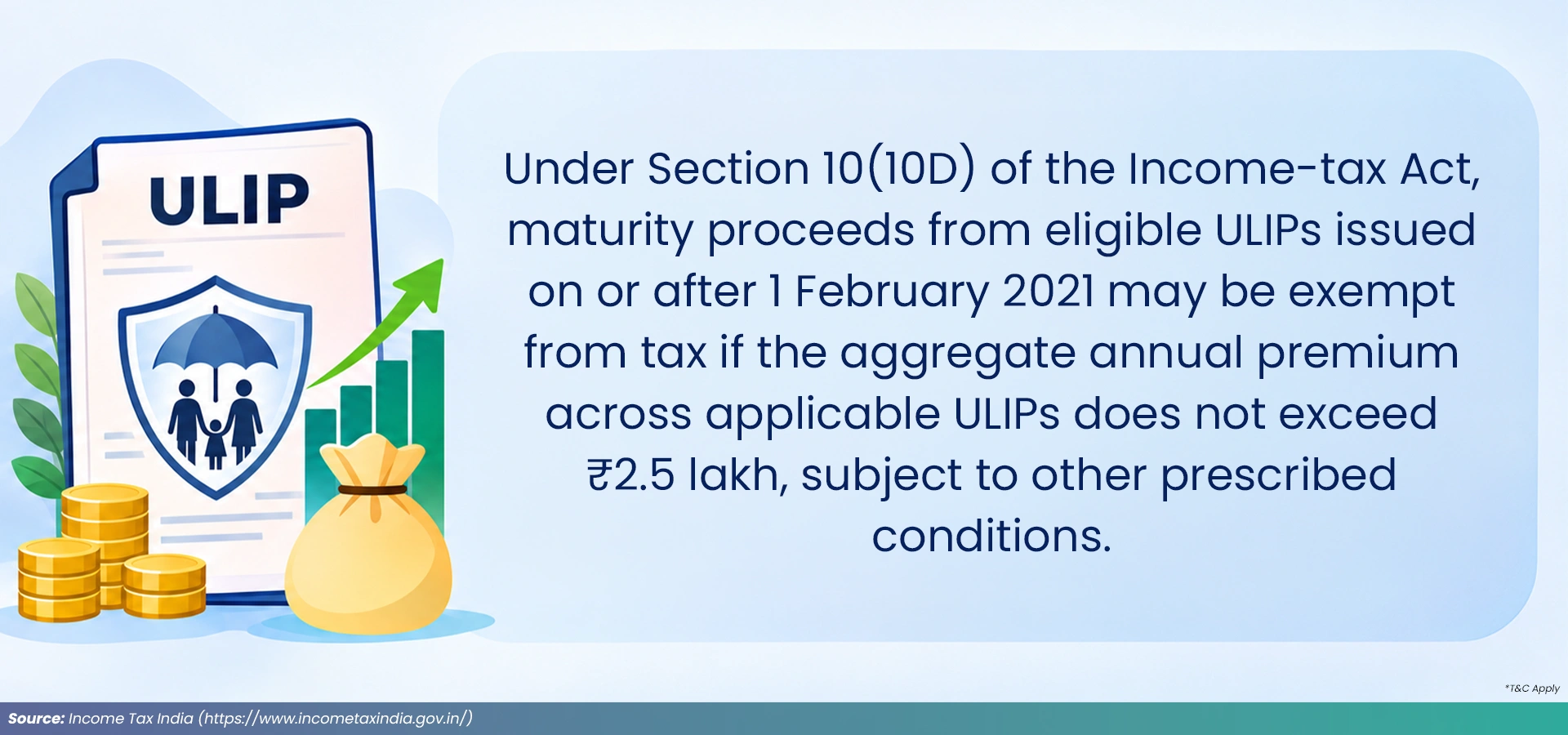
| Maturity proceeds | Exempt from tax if the total annual premium of all your ULIPs issued on or after 1 February 2021 is ₹2.5 lakh or less, and the other conditions are met. |
| Annual premium above ₹2.5 lakh | The gains are taxed as capital gains. For an equity-orientated ULIP held for more than 12 months, the long-term rate is 12.5% on gains above ₹1.25 lakh in a year, plus cess. |
| Death benefit | Generally tax-free in the hands of the nominee. |
| Switching between funds | Generally not taxed while the money stays inside the policy. |
| GST on premium | Nil on individual life insurance premiums, including ULIPs, since 22 September 2025. |
So a ULIP with a yearly premium of ₹1,00,000 can enjoy the tax-free maturity rule, while a ULIP with a yearly premium of ₹3,00,000 cannot, and the limit applies to the combined premium of all your ULIPs and not to each policy separately. Tax laws and their interpretation change from time to time, so please confirm your own position with a chartered accountant.
ULIP vs mutual fund is the comparison almost every investor makes, and the honest answer is that neither is better for everyone, because they are built for different jobs. A mutual fund is a pure investment, while a ULIP combines an investment with life cover. The differences are easiest to see side by side:
| Feature | ULIP | Mutual fund |
| Purpose | Life cover and investing in one policy | Investing only |
| Life cover | Included, with the cost deducted as a mortality charge | None |
| Lock-in | 5 years for all ULIPs | None for most funds, 3 years for tax-saving ELSS funds |
| Charges | Several: allocation, fund management, administration, mortality | Mainly the fund’s expense ratio, plus any exit load |
| Switching between funds | Allowed inside the policy, generally without tax | Selling and buying is a taxable event. |
| Tax on gains | Maturity is exempt if the annual premium is up to ₹2.5 lakh; otherwise, capital gains. | Capital gains tax on redemption. |
| Access to money | Restricted for 5 years, then partial withdrawals | Usually redeemable at any time, except ELSS during its lock-in. |
| Who carries the market risk? | The policyholder. | The investor. |
If all you want is investment growth and you value easy access to your money, a mutual fund is usually simpler and cheaper. If you want life cover and a forced long-term discipline in the same policy, and you can commit for a decade or more, an ULIP can be a reasonable fit, and many people use both for different goals.
Long-term investment plans work best when they are tied to a goal with a date, and here is how a ULIP may fit some common ones:
| Goal | Time away | How a ULIP may fit | Watch out for |
| Child’s higher education | 12 to 18 years | Equity-heavy funds early on, moving to debt as the date nears. | Do not stop premiums midway. |
| Retirement | 20 years or more | Long horizons let equity funds ride out market cycles. | Compare charges over 20 years and not only 5. |
| House down payment | 10 to 12 years | Balanced funds with a gradual shift to debt. | Plan the withdrawal date well before you need the money. |
| Emergency fund or a goal under 5 years | Under 5 years | Not suitable, because of the lock-in and market risk. | Use a savings account, liquid fund or deposit instead. |
Going back to Ritika, her retirement goal, which is 25 years away, is a natural match for a long-term plan, while her house goal, 12 years away, can be handled with a more balanced fund choice, and neither goal needs money that she might have to touch in the next five years, which is the condition that matters most.
| A ULIP may suit you if | A ULIP may not suit you if |
| Your goal is 10 to 15 years or more away. | You may need the money within 5 years. |
| You want life cover and investing in one policy. | Your main need is high life cover at a low cost, where a term plan is usually better |
| You are comfortable with your fund value moving up and down. | You want guaranteed or assured returns. |
| You can pay premiums for the entire term without stress. | Your income is irregular, and you may not keep up the premiums. |
| You have read the charges and are fine with them. | You are buying because of a phone call or a sales push. |
Before you invest in a ULIP, four checks are worth the time. The first is the insurer, so look at its claim settlement ratio and its track record, because the policy is only as good as the company that stands behind it. The second is the funds, so look at how they have performed across a full market cycle and how their risk matches your own, remembering that past numbers are a guide and not a promise. The third is the charges, so compare the allocation, fund management and other charges of at least two or three plans. The fourth is the goal, so know exactly what the money is for, when you need it and what premium you can keep paying comfortably for the whole term.
Then read the benefit illustration and the policy document, and note the free-look period, which is a short window after you receive the policy (usually about 30 days) during which you can review the terms and return the policy if they do not suit you, with the insurer deducting only the permitted charges.
Finkeda is not an insurer, and the ULIP you choose is issued, managed and serviced by the life insurer whose plan it is. What Finkeda does is help you explore and compare life insurance options, including ULIPs, from insurers on its platform, and its team can guide you through the steps in simple language, which is useful if you would rather talk to someone than read a long document alone. The usual journey looks like this:
| # | Step | What you do |
| 1 | Get in touch. | Call the Finkeda team and share your details. |
| 2 | Share your goal. | Tell the team your age, income and the goal you are investing for so that plans can be matched to your horizon and comfort with risk. |
| 3 | Compare plans. | Look at plans from different insurers side by side, including premiums, benefits, charges and claim settlement ratios. |
| 4 | Read before you decide. | Go through the benefit illustration and the policy terms of the plan you like, and ask about anything you do not understand. |
| 5 | Apply and pay. | Complete the application and KYC, and pay the first premium through UPI, card, net banking or a digital wallet. |
| 6 | Receive your policy. | The insurer issues the policy, and your documents are shared with you securely. Check the details and the free-look period. |
The insurer decides whether to accept the proposal, and any medical or other checks that the plan needs are handled as per the insurer’s rules. Keep your policy documents safe, and note the premium due dates so that the policy does not lapse.
The five-year lock-in and the heavier charges in the early years mean that a ULIP works against you if you exit after a few years, so it should only be used for goals that are far away.
Fund values move with the market, and it is possible for the value to be lower than the premiums paid, particularly in the first years, so no return figure should be taken as a promise.
A plan with attractive fund options can still be expensive, and a difference of even one percentage point a year adds up to a large amount over fifteen or twenty years.
Discontinuing a ULIP early triggers discontinuance charges and locks the remaining money in a low-return fund until the lock-in ends, so only commit to a premium you can pay for the whole term.
If the total annual premium of your ULIPs crosses ₹2.5 lakh, the tax-free maturity benefit no longer applies to the policies issued after 1 February 2021, and it is much better to know this before buying than after.
A ULIP is a long commitment, and an unsolicited call or a rushed decision is not the right way to make it, so take your time, compare plans and read the documents.
A ULIP can be a sensible part of a long-term plan when the goal is far away, when you value life cover and market-linked investing in a single policy, when you understand the charges and the lock-in, and when you are willing to stay invested through the ups and downs of the market. It is a poor choice for short-term money, for anyone looking for guaranteed returns, and for anyone who has not read the terms.
If you would like to explore ULIPs, Finkeda can help you compare plans from insurers and guide you through the process, and the final policy will be issued by the insurer you choose.
A ULIP is regulated by the insurance regulator, IRDAI, but regulation does not remove market risk. In a ULIP the investment risk is carried by the policyholder, so the fund value can go up or down, and equity funds in particular can be volatile.
No. Every ULIP has a five-year lock-in, during which you cannot withdraw or surrender the policy for cash. After it ends, partial withdrawals are usually allowed as per the plan.
If you stop before the lock-in ends, the policy is discontinued, a discontinuance charge may apply, and the remaining money is moved to a discontinued policy fund that earns a minimum of about 4% a year and is paid to you after the lock-in. Please check your policy document for the exact terms.
No. The maturity proceeds are exempt only when the total annual premium of your ULIPs issued on or after 1 February 2021 is ₹2.5 lakh or less and other conditions are met. Above that, the gains are taxed as capital gains.
Neither is better for everyone. A mutual fund is a pure investment with easier access to your money, while a ULIP adds life cover and a five-year lock-in. The right choice depends on your goal, your time horizon and whether you need the insurance.
Yes. Most ULIPs allow you to switch between equity, debt and balanced funds. A limited number of free switches is usually allowed each year, and the plan may charge a small fee after that.
The sum assured is generally required to be at least ten times the annual premium for most policyholders, and the death benefit is usually the higher of the sum assured or the fund value, as per the plan.
Yes, you can explore and compare ULIPs from insurers through Finkeda and get help from the Finkeda team. The policy is issued by the insurer, and the insurer is responsible for the plan, the funds and claims.
Disclaimer: This content is for general informational purposes only and is not financial or investment advice. ULIP returns are market-linked and not guaranteed. Policy terms, charges, lock-in period and tax benefits are subject to applicable conditions. Please read the policy documents carefully and consult a qualified financial advisor before investing. Finkeda facilitates access to ULIP options; policies are issued and managed by respective insurers.
Share :
Like:
0