
Nov. 25, 2026

19 Min read

Travel

Share :


Subtitle: A practical look at how the Sharma family planned their first cruise, from choosing the right arrangements to preparing for a smooth journey.
Planning a family cruise trip involves more than choosing a destination and booking a cabin. Families need to consider cruise routes, accommodation, travel documents, visa requirements, budgeting, packing, embarkation procedures and shore excursions to make their journey comfortable and well organised.
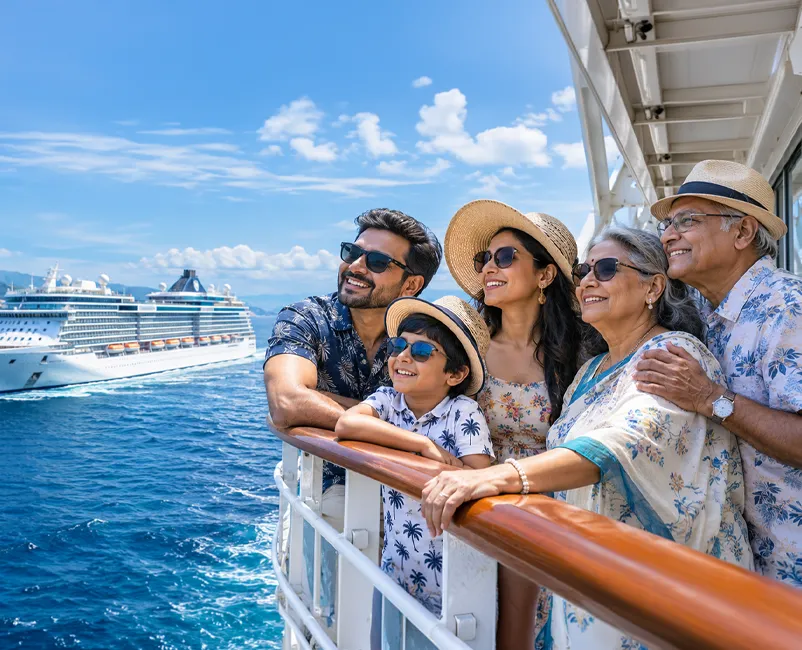
This blog follows the Sharma family as they prepare for their first cruise with their daughter, Ananya, and her grandparents. It explains how families can compare domestic and international cruise options, select suitable cabins, organise travel documents, estimate expenses and plan shore excursions while considering the needs of different age groups.
With practical examples and a step-by-step planning timeline, the guide helps readers understand the essential aspects of organising a family cruise. It also introduces Tripround, Powered by Finkeda, as a starting point for exploring travel options, subject to availability and package inclusions.
Through the Sharma family’s first cruise-planning experience, this article takes readers through the key decisions involved in organising a family holiday at sea. From selecting an itinerary and cabin to preparing passports and visas, estimating onboard expenses and packing essential items, it highlights the practical considerations that can make a cruise more comfortable for every family member.
The article also covers important travel precautions, including arriving at the departure city early, understanding onboard payment systems, preparing for possible seasickness and returning to the ship before its scheduled departure. Special attention is given to planning for children and elderly family members.
The central takeaway is that thoughtful preparation helps families avoid common travel complications and enjoy their cruise with greater confidence. The article also points readers towards Tripround, Powered by Finkeda, for exploring suitable travel options.

A cruise holiday may look effortless once the ship leaves the harbour, but the experience starts long before embarkation day.
International itineraries can include several countries, each with its own entry requirements. Cruise lines also have specific boarding rules, luggage policies and departure schedules.
The Sharmas discover that their planning checklist needs to cover much more than choosing a destination. They must consider how far the port is from the airport, whether their cabin is suitable for different age groups, which documents each traveller needs, what their fare includes and how much time they should allow for exploring each destination.
A well-planned cruise is one that suits the family’s travel style, comfort needs and budget, rather than simply being the most expensive. It is the one that matches the family’s travel style, comfort requirements and budget.
Planning milestone: Approximately 150 days before departure.
The first discussion begins around the dining table. Rajesh prefers starting with an Indian sailing, as it seems simpler to organise, while Neha wants Ananya to experience another country during the same holiday. Both options have their advantages, but the right choice depends on the family’s available time, travel documents, budget and preferred experiences.
Before booking, they compare domestic and international cruise options.
| Feature | Domestic Indian Sailings | International Sailings |
| Possible departure gateways | Mumbai, Kochi, Chennai | Singapore, Dubai, Athens |
| Passport requirements | Depend on the sailing, operator and applicable rules. | Generally required; validity requirements vary |
| Visa requirements | Depend on the itinerary and applicable entry rules. | Tourist, transit or other visas may be required. |
| Onboard currency | Depends on the cruise operator. | May be USD, EUR, SGD or another operator-defined currency |
| Flights to departure port | Domestic flights or surface transport | International flights and airport transfers |
| Planning considerations | Domestic travel logistics and port requirements | Passports, visas, international flights and port-entry rules |
This table provides a starting point rather than a universal rulebook. Families should confirm the requirements for their exact itinerary before making non-refundable bookings.
Mumbai to Goa and Back
If available, a short sailing between Mumbai and Goa could be an attractive option for a family looking for a taste of life at sea without committing to a longer international holiday. A short itinerary may allow families to enjoy onboard dining, entertainment and ocean views while keeping the overall trip relatively compact.
For the Sharmas, this could be an ideal introduction to cruising. The grandparents could spend more time relaxing onboard without having to navigate multiple airports and international entry procedures.
Mumbai, Kochi and Lakshadweep
For families who love marine landscapes, island scenery and a more adventurous holiday, a longer coastal itinerary including Lakshadweep and Kochi could be worth exploring. However, the exact ports, sailing dates and island stops depend on the operator and itinerary.
Some islands may require special permits or additional arrangements. Families should verify whether these are included in their cruise package instead of assuming that the cruise fare covers every shore visit.
Chennai and the East Coast of India
If you are looking for shorter shore excursions and opportunities to explore coastal culture, consider sailings featuring ports such as Puducherry or Visakhapatnam, where available.
Such routes may appeal to families who enjoy a combination of time at sea, local sightseeing, cultural attractions and regional food. Availability depends on the season and cruise operator, so always check the destinations against the actual sailing schedule.
Neha remains interested in an international experience, but she does not want a route that leaves the grandparents exhausted before the holiday even begins.
Three broad options make their shortlist.
Southeast Asia: Singapore, Malaysia and Thailand
A cruise departing from Singapore and visiting selected ports in Malaysia or Thailand can combine urban attractions, coastal scenery, shopping and cultural experiences. Singapore may also give families the opportunity to spend a day or two exploring before embarkation.
Ananya can explore attractions in Singapore or spend a day in Penang or Phuket, then return to the ship for dinner without having to change accommodation at each stop.
Meanwhile, Rajesh and Neha can organise sightseeing at the grandparents’ preferred pace.
Middle East: Dubai, Abu Dhabi and Oman
Selected Arabian Gulf itineraries combine modern city attractions, shopping, waterfront experiences and cultural excursions. Depending on the season and sailing route, families may also be able to explore Dubai, Abu Dhabi or destinations in Oman.
Before making a decision, the Sharmas would check flight schedules, seasonal conditions, visa requirements and the amount of walking involved in shore excursions. The appeal is not simply the number of destinations but whether each stop is manageable for everyone travelling together.
Western Mediterranean: A Longer Cultural Journey
For families with more time, a Mediterranean cruise can bring together historic cities, architecture, museums and coastal destinations. Depending on the itinerary, cruise stops may include Barcelona, Rome and Marseille.
The main advantage is that the family can return to the same cabin after each excursion instead of changing hotels between destinations. However, travelling between cruise terminals and major city attractions can take considerable time, so excursion distances deserve careful attention.
The Sharma Family’s Decision
After comparing the options, Rajesh and Neha shortlist a four-night Singapore-based cruise visiting selected destinations in Malaysia and Thailand, subject to sailing availability.
It offers Ananya the international experience Neha wanted while giving the grandparents a manageable itinerary. The family also decides to arrive in Singapore before embarkation rather than risk beginning the holiday with a rushed airport transfer.
For travellers considering a similar trip, Tripround Powered By Finkeda can be a starting point for exploring suitable holiday packages, comparing travel arrangements and coordinating the details connecting flights, hotel stays and cruise departures, depending on the services available.
Planning milestone: Approximately 120 days before departure.
Rajesh opens the cruise ship’s deck plan, revealing a range of cabin categories: interior rooms, ocean-view cabins, balcony staterooms and suites. Some are located towards the front of the ship, others near the stern, and many occupy different deck levels.
The family quickly realises that cabin selection is not just about the view. It is also about comfort, accessibility, noise and the distance to shared facilities.
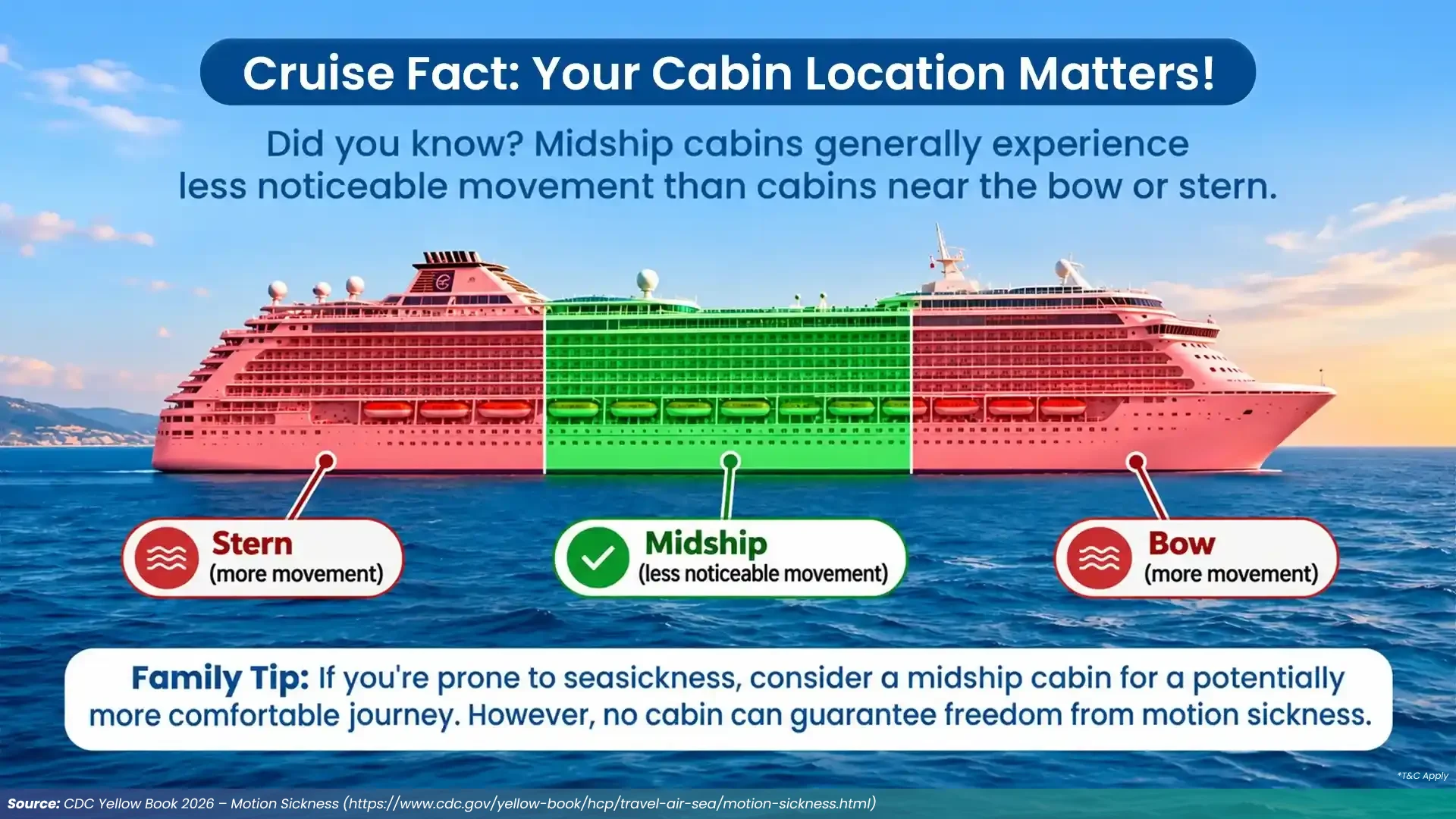
A ship can pitch, roll and yaw as it moves through the water. The degree of movement depends on factors including the vessel’s design, sea conditions, speed and weather.
Travellers concerned about motion often receive recommendations for cabins near the middle of the ship, commonly called midship cabins, because these cabins are closer to the vessel’s centre of movement. Lower decks may also experience less movement than higher decks in some conditions.
However, no cabin can guarantee freedom from seasickness, and individual sensitivity varies.
For the Sharmas, a midship cabin on a suitable deck is a sensible option to investigate. Rajesh also checks the walking distance to lifts, dining areas and medical facilities so the grandparents do not have to navigate long corridors repeatedly.
| Cabin Type | What to Expect | Best Suited For |
| Interior cabin | No exterior window; usually among the more budget-friendly choices | Families prioritising onboard activities and value |
| Ocean-view cabin | A window or porthole providing natural light | Travellers who want a view without paying for a balcony |
| Balcony cabin | Private outdoor space, depending on the cabin design | Families who enjoy fresh air and quiet time |
| Suite | More space and potentially additional amenities | Families seeking extra room or a higher level of comfort |
The Sharmas compare two nearby cabins rather than automatically booking the most expensive suite. This gives them a practical balance between privacy, convenience and budget.
Suppose an interior cabin costs less than an ocean-view cabin, but the price difference for a balcony cabin is relatively small for a particular sailing. Instead of selecting a category based on its name, the family compares the total cost for all travellers, the cabin layout, accessibility and cancellation terms.
They also investigate partially obstructed ocean-view cabins. Some may be cheaper and offer natural light, but the degree of obstruction varies from one room to another. Families should review the actual deck plan and cabin description before booking.
Those requiring connecting cabins or rooms next to each other should plan early to improve their chances of finding suitable options, although availability cannot be guaranteed.
Planning milestone: Approximately 90 days before departure, or earlier if required.
After shortlisting the route, Neha creates a shared document checklist for each family member. This is where the little details matter. Even with confirmed flights and cruise tickets, travel plans can be disrupted by a passport expiring too soon, a missing visa or an incorrect passenger name.
The Sharmas check the passports of Rajesh, Neha, Ananya and the grandparents. They compare the expiry dates with the cruise departure and return dates, destination requirements and any relevant airline or transit rules.
Some destinations and carriers require passports to remain valid for six months or more beyond a specified date. Other requirements may differ. Therefore, the family checks the rules applicable to Indian passport holders for every country on the itinerary.
If a passport needs to be renewed, they arrange the renewal well in advance rather than waiting for an urgent appointment just before the sailing date.
A cruise that stops in several countries can have more complicated entry requirements than a trip involving only one destination.
For example, the Sharma family’s itinerary from Singapore may include a port of call in Malaysia and another in Thailand before returning to Singapore. The documents required will depend on the travellers’ nationality, the countries they visit, the nature of each port call and the prevailing immigration rules.
The family checks whether each traveller needs a visa, whether the visa allows the intended number of entries and whether any transit or cruise-specific arrangements apply. They also check the cruise operator’s documentation requirements.
A visa permitting one entry should never be assumed to cover every itinerary simply because the passenger returns to the original departure country.
| Document or Requirement | What the Family Should Check |
| Passport | Validity and condition for every traveller |
| Visa or entry authorisation | Requirements for each destination and transit point |
| Cruise confirmation | Passenger names, sailing dates and cabin details |
| Flight and hotel bookings | Arrival times, transfers and cancellation terms |
| Travel insurance | Medical cover, emergency assistance and relevant exclusions |
| Minor travel documents | Additional consent or supporting documents, where applicable |
| Printed and digital copies | Secure access to essential confirmations and documents |
Ananya’s travel documents are similar to those of the adults. However, the destination, carrier or relevant authorities may require or recommend additional documentation when a minor travels with only one parent or with relatives.
The exact requirements differ. The family checks whether consent letters, birth certificates, custody documents or other supporting paperwork may be needed rather than assuming that one rule applies to every country.
The same consideration applies to medical documentation, prescribed medicines and accessibility arrangements for older travellers.
Before travelling on a multi-country cruise, the safest approach is to check the requirements directly with the relevant official authorities and the cruise operator.
Planning milestone: Approximately 60 days before departure.
Rajesh first checks the advertised cruise price. But Neha wants to know how much the family will have spent by the time they return home.
They discover that a cruise fare can include accommodation, some meals, entertainment and access to selected facilities, but it does not necessarily cover every onboard or shore-side expense.
Instead of treating the booking price as the final cost, the family divides the budget into several categories.
| Expense Category | What to Include |
| Cruise fare | Cabin, including meals and standard entertainment |
| Flights and hotels | Return flights, pre-cruise accommodation and transfers |
| Service charges | Applicable daily gratuities or service fees |
| Shore excursions | Guided tours, attraction tickets and local transport |
| Onboard extras | Speciality dining, selected drinks, Wi-Fi and spa services |
| Travel essentials | Insurance, visas, medicines and other necessary documents |
| Contingency fund | Unexpected transport costs, schedule changes or additional expenses |
The actual proportions will vary by itinerary and family size. Rajesh builds the budget using the prices and inclusions of the cruise they have shortlisted instead of relying on a universal percentage split.
Many cruise ships have a cabin-linked account or keycard system for making purchases. Charges vary by operator and may include specialty restaurants, beverages, selected activities, internet packages and service fees.
The family checks what is included in the fare, what must be paid for separately and how the final bill is settled. They also review the cruise line’s gratuity policy, as charges may be added automatically or handled differently depending on the booking.
This simple step prevents the family from confusing a partially inclusive fare with an all-inclusive holiday.
Maritime networks or satellite-linked services may provide mobile connectivity at sea, but charges can be very different from normal domestic roaming rates.
Before leaving, Neha checks the terms for international and maritime roaming with her mobile provider. The family considers the ship’s internet package if needed and keeps mobile data settings under control while sailing.
They also download important booking confirmations, maps and entertainment in advance so they do not have to depend on a constant internet connection.
Planning milestone: Approximately 14 days before departure.
Packing for a cruise is a little different from packing for a hotel holiday. Families may need clothing for daytime sightseeing, pool activities, formal evenings and changing weather conditions, while keeping essential items accessible on embarkation day.
Neha separates the luggage into two parts: a small hand-carry bag for the family and the main suitcases, packed according to the cruise operator’s guidelines.
The family’s essential bag contains travel documents, prescribed medicines, a phone charger, valuables, necessary child-related items and a change of clothing. Swimwear is also included if the family hopes to use the pool before the checked luggage arrives.
This is particularly useful when checked luggage is delivered to cabins later in the day.
The main suitcase contains casual clothes, comfortable shoes, evening wear, toiletries permitted by the carrier and accessories appropriate for the destinations.
The Sharmas check the weather forecast for each port and avoid packing a different outfit for every possible activity. They keep lightweight layers, comfortable walking shoes and clothing suitable for cultural or religious sites ready without overpacking.
Cruise ships have specific safety restrictions. Household irons, some heating appliances, prohibited power strips and other items may be restricted or confiscated under the operator’s rules.
Rajesh does not rely on a generic packing list. Instead, he checks the cruise line’s prohibited-items policy to confirm which charging equipment and personal appliances are allowed.
The family also keeps prescription medicines in their original packaging where practical and carries essential medication in their hand luggage.
Planning milestone: One day before departure and the first day onboard.
The Sharmas choose not to fly into Singapore on the morning of the cruise. Instead, they arrive a day earlier, check into a hotel and allow themselves time to recover from the journey.
This buffer provides some protection against flight delays, traffic disruptions and luggage problems. It also gives Ananya a chance to explore a little of Singapore before the cruise begins.
Cruise lines establish embarkation windows, check-in requirements and terminal procedures. The family follows its assigned check-in time rather than assuming that arriving several hours early will guarantee immediate boarding.
They keep their passports, cruise confirmations and other required documents accessible and check that all passenger details match the reservation.
Once onboard, they locate their muster station, familiarise themselves with the layout of the ship and complete the mandatory safety procedures within the time specified by the operator.
The ship moves into open water, and Ananya watches the horizon change. However, Rajesh’s father begins to feel a little uncomfortable.
The family takes a measured approach. He sits somewhere comfortable, looks towards the horizon if that helps, drinks water and eats lightly. The family has also discussed seasickness with a healthcare professional before travelling and understands which medicines, if any, may be suitable for him.
Some travellers find that fresh air and simple food help them feel more comfortable, but no particular food or home remedy is a guaranteed treatment for motion sickness. Persistent or severe symptoms should be discussed with the ship’s medical team.
This is another reason the Sharmas considered cabin location and accessibility before making their booking.
Ananya soon discovers that a cruise is more than a way to reach another country. Depending on the ship, she may have access to children’s activities, swimming pools, shows, games and family entertainment.
The grandparents enjoy quiet lounges and leisurely meals, while Rajesh and Neha explore the ship together.
The family also checks the daily programme so they can choose activities without turning every hour into a scheduled appointment.
A cruise itinerary may allow only a limited number of hours in each destination. The family therefore learns to plan shore excursions around the actual arrival time, departure deadline and distance between the port and the attractions.
In Phuket, for example, Ananya wants to visit a popular attraction, while Rajesh hopes to explore a local market. The grandparents would prefer a shorter excursion with comfortable transport and places to sit.
Rather than trying to cover everything, the family chooses one main activity and keeps enough time in reserve for the return journey.
Cruise line excursions can be convenient when attractions are far from the port, local transportation is difficult or the family prefers a guided experience. Some cruise lines may offer specific protections, such as flexible cancellation or itinerary change policies, subject to their terms and conditions. If an organised excursion is delayed, but the exact terms should always be checked with the operator.
With a familiar route and reliable transportation, a family may enjoy greater freedom by exploring nearby attractions independently.
However, independent travellers must account for traffic, queues, transport availability and the time needed to return through port security. A ship will not necessarily wait for passengers who return late after arranging their own excursion.
| Situation | Planning Approach |
| Attraction is far from the port | Consider a reputable organised excursion |
| Family includes travellers with limited mobility | Choose accessible transport and a manageable schedule |
| Attraction is close to the port | Independent exploration may be practical |
| Destination has complex transport or entry requirements | Check local arrangements before choosing |
| Ship departure is relatively soon after the visit | Select a shorter activity and return with a generous time buffer |
The Sharmas make it a rule to follow the ship’s stated all-aboard time and use the vessel’s local time as instructed by the operator. They do not rely solely on a phone clock, particularly when visiting a destination in a different time zone.
Their guiding principle is straightforward: a memorable excursion is one that ends with everyone safely back onboard, without a last-minute race to the gangway.
A cruise becomes easier to manage when the major decisions are spread across several months rather than left until the final week.
| When | What the Sharma Family Does |
| Around 150 days before departure | Compares destinations, sailing dates, cruise lines and overall budgets |
| Around 120 days before departure | Reviews passport validity, cabin choices and accessibility requirements |
| Around 90 days before departure | Checks visa requirements and begins arranging the required documents |
| Around 60 days before departure | Reviews onboard charges, service fees, insurance and excursion options |
| Around 30 days before departure | Completes available online check-in procedures and confirms transport arrangements. |
| Around 14 days before departure | Checks the packing list, weather and permitted luggage items |
| Around 7 days before departure | Reconfirms flights, hotel reservations, cruise instructions and document copies |
| One day before sailing, when practical | Arrives in the departure city and stays overnight |
| Embarkation day | Follows the assigned check-in window and completes safety procedures |
These are planning milestones rather than universal deadlines. Visa processing times, booking windows and check-in procedures vary, so the family’s schedule must be adjusted to the actual itinerary.
By the time the Sharmas finish their checklist, they understand that the hardest part of a family cruise is often coordinating the details before the ship leaves the harbour. Flights must align with embarkation, hotel stays must fit the travel schedule, and the chosen itinerary must work for children, parents and grandparents alike.
This is where Tripround Powered By Finkeda can help families explore holiday options and organise their wider travel plans around a cruise. Depending on the package selected and the services available, this may involve comparing departure cities, pre-cruise accommodation, transfer arrangements and sightseeing plans around the sailing schedule.
For example, a family considering a cruise departing from Singapore could plan a short stay in the city before boarding, followed by a suitable cruise itinerary and a planned return journey. Another family might prefer to investigate a domestic coastal holiday with fewer international travel formalities.
The important point is to choose an itinerary that fits the people travelling, rather than selecting a destination simply because it looks impressive in a brochure.
Before making a booking, check the package details, inclusions, availability and applicable booking conditions.
Preparing for a cruise gives the Sharma family a chance to think about the holiday they want to enjoy together. Rajesh takes care of the practical arrangements, Neha looks for places worth remembering, and Ananya imagines the places she will discover. The grandparents remind everyone that a good holiday needs room for both rest and adventure.
Their experience illustrates an important principle: the success of a cruise is not measured by the number of ports visited or the price of the cabin. It is measured by the ease of the journey, the comfort of the family, how well the practical details are managed and how much everyone enjoys the experience.
Before booking, families should review the cruise operator’s boarding deadlines, baggage limits, cancellation terms and onboard payment policies. Checking these details in advance can help avoid unexpected costs and last-minute complications during the trip.
The longest or most luxurious cruise is not necessarily the best choice. It is the one that brings everyone together, makes the journey enjoyable and leaves the family with stories to tell long after they have returned home.
This article is intended for general informational and educational purposes only. The Sharma family is an illustrative example used to explain common cruise-planning considerations. The itinerary and situations described should not be interpreted as a confirmed booking or a guarantee of particular travel arrangements.
Cruise routes, sailing schedules, cabin availability, package prices, onboard inclusions, service charges, passport validity requirements, visa rules, transit permissions, insurance conditions and port procedures vary by cruise operator, destination and traveller nationality. Requirements may change without notice.
Travellers should verify the applicable rules with the relevant government authorities, embassies or consulates, airline and cruise operator before booking or departure. Medical concerns, including motion sickness and accessibility needs, should be discussed with an appropriate healthcare professional where necessary.
Any services, inclusions and arrangements offered by Tripround Powered By Finkeda are subject to the specific package description, availability and applicable booking terms. This guide does not constitute immigration, legal, medical or financial advice.
Start by choosing a cruise itinerary that suits your family’s budget, travel preferences and available time. Book a suitable cabin, check passport and visa requirements, plan your expenses, pack essential items and review the cruise operator’s boarding instructions. Arriving at the departure city a day early can also help reduce last-minute travel stress.
Carry travel documents, prescribed medicines, comfortable clothing, swimwear, sunscreen, reusable water bottles where permitted, chargers and essential child-related items. Keep important documents, valuables, medicines and a change of clothes in your hand luggage, as checked luggage may take time to reach your cabin. Always check the cruise line’s luggage and prohibited-items policy before packing.
Depending on the itinerary and traveller nationality, you may need valid passports, visas or entry authorisations, cruise booking confirmations, flight and hotel details, travel insurance and additional documents for children where applicable. Check the entry requirements for every destination and transit point with the relevant official authorities and cruise operator before departure.
Tripround Powered By Finkeda can be a starting point for exploring travel options and planning arrangements around a family cruise. Depending on the services available, families can look into suitable travel packages, pre-cruise accommodation, transfers and other arrangements connected with their itinerary. Check the specific package details and inclusions before booking.
Booking several months in advance is a practical approach, particularly for school holidays, peak travel seasons or families requiring specific cabin arrangements. Starting around four to six months ahead can give you more time to compare itineraries, review prices and prepare travel documents. However, the ideal booking time depends on the cruise operator, destination, sailing dates and availability.
Tripround Powered By Finkeda can help travellers explore available travel options and related arrangements, depending on the services and packages it offers. Before booking a cruise, hotel stay, transfer or other travel service, confirm the availability, inclusions, payment terms and cancellation conditions directly through the applicable booking channel.
Share :
Like:
0