
Nov. 16, 2026

8 Min read

Investments

Share :


Every investor who opens an investment platform eventually reaches the same fork in the road. One path asks for a modest amount every month through a Systematic Investment Plan (SIP), and the other asks for a large amount in a single transaction, known as a lump sum investment. Both approaches put your money to work in the market, but the risk profile, cash-flow commitment, and final outcomes differ significantly.
Whether you are automating your monthly savings or looking to deploy surplus capital, this guide breaks down how each approach works, where each excels, and how you can seamlessly execute the right strategy through Finkeda for 2027 and beyond.
A SIP spreads your capital across market cycles to deliver rupee cost averaging, while a lump sum puts your money to work immediately on day one. Neither method is universally superior; the optimal choice depends on your cash flow frequency, time horizon, and behavioral tolerance for volatility. In this guide, you will find direct comparisons, practical numerical scenarios, hybrid deployment routes, and steps to align your portfolio through Finkeda’s curated mutual fund solutions.
Imagine two investors, Riya and Karan, who both decide to start investing in equity mutual funds in the same month.
Both approaches are strategically sound. Riya avoids timing anxiety because her entry points are automated. Karan maximises compounding exposure from day one, though he must withstand early volatility.
Plan Your Route Through Finkeda: Whether your capital arrives every 30 days or as a one-time windfall, Finkeda helps you to set up paperless SIP mandates or execute lump sum transactions across top-rated schemes.
The core distinction lies in deployment frequency and market exposure timing.
A SIP establishes an automated recurring instruction (monthly, quarterly, or weekly) to invest a predetermined sum into a selected mutual fund scheme. Units are allotted based on that day’s Net Asset Value (NAV).
Over time, this mechanism averages out your acquisition cost (Rupee Cost Averaging) without requiring you to time market peaks and valleys.
A lump sum allocates your entire capital on day one at the prevailing NAV. If you invest ₹6 lakh at an NAV of ₹50, you receive 12,000 units immediately. The entire corpus participates in every upward and downward market swing from that moment forward.
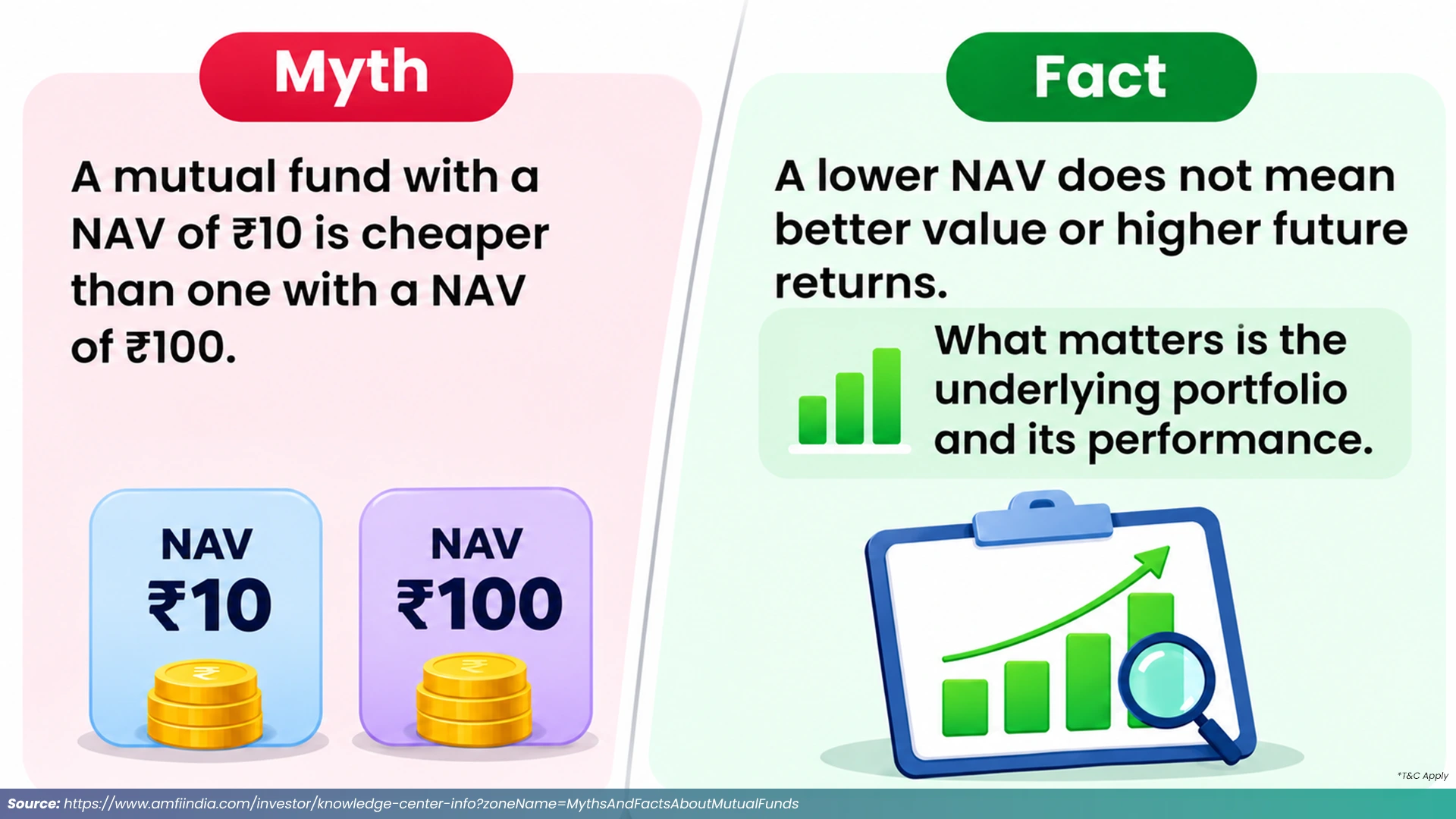
Side-by-Side Comparison
| Feature | Systematic Investment Plan (SIP) | Lump Sum Investment |
| Execution | Fixed recurring instalments | Single one-time transaction |
| Capital Source | Regular monthly cash flow / salary | Windfalls, bonuses, asset sales, FD maturities |
| NAV Exposure | Averaged across market cycles | Fixed at the date of purchase |
| Market Timing Risk | Minimal | High over short holding windows |
| Compounding Window | Staggered across instalments | Full corpus compounds from Day 1 |
| Minimum Ticket | Starts as low as ₹100 – ₹500 Through Finkeda | Generally ₹1,000 – ₹5,000 depending on the fund |
Market trajectories cannot be predicted with certainty. A robust allocation strategy focuses on structural fit rather than market timing:
Investor Note: Before investing, review the scheme’s valuation, risk grade, historical performance and relevant offer documents to make an informed decision.
Hypothetical Comparison (For Illustration Purposes Only)
Suppose ₹12 lakh is invested over a 10-year horizon at an assumed 12% annualised return:
While the lump sum figure is higher, it assumes the investor had ₹12 lakh idle on Day 1. For salaried professionals, a disciplined SIP turns regular cash flow into substantial wealth without requiring idle upfront capital.
Opt for a SIP when:
Opt for a Lump Sum when:
You don’t have to choose exclusively between all-at-once or monthly instalments. If you hold a lump sum but fear market corrections:
| Financial Goal | Suggested Horizon | Recommended Strategy via Finkeda |
| Emergency Buffer | Instant / 0–1 Year | Lump sum in Liquid / Overnight Funds |
| Short-Term Goal | 1 to 3 Years | Staggered or Lump sum in Conservative Hybrid / Short-Duration Funds |
| Mid-Term Purchase (House, Car) | 5 to 7 Years | Hybrid Funds via SIP with periodic bonus top-ups |
| Retirement / Long-Term Wealth | 10+ Years | Diversified Equity Funds via Step-Up SIP |
Common Pitfalls to Avoid
Get Started through Finkeda
Whether you are beginning your wealth-creation journey with a ₹500 monthly SIP or deploying a portfolio windfall, Finkeda provides institutional-grade fund analytics, and frictionless execution:
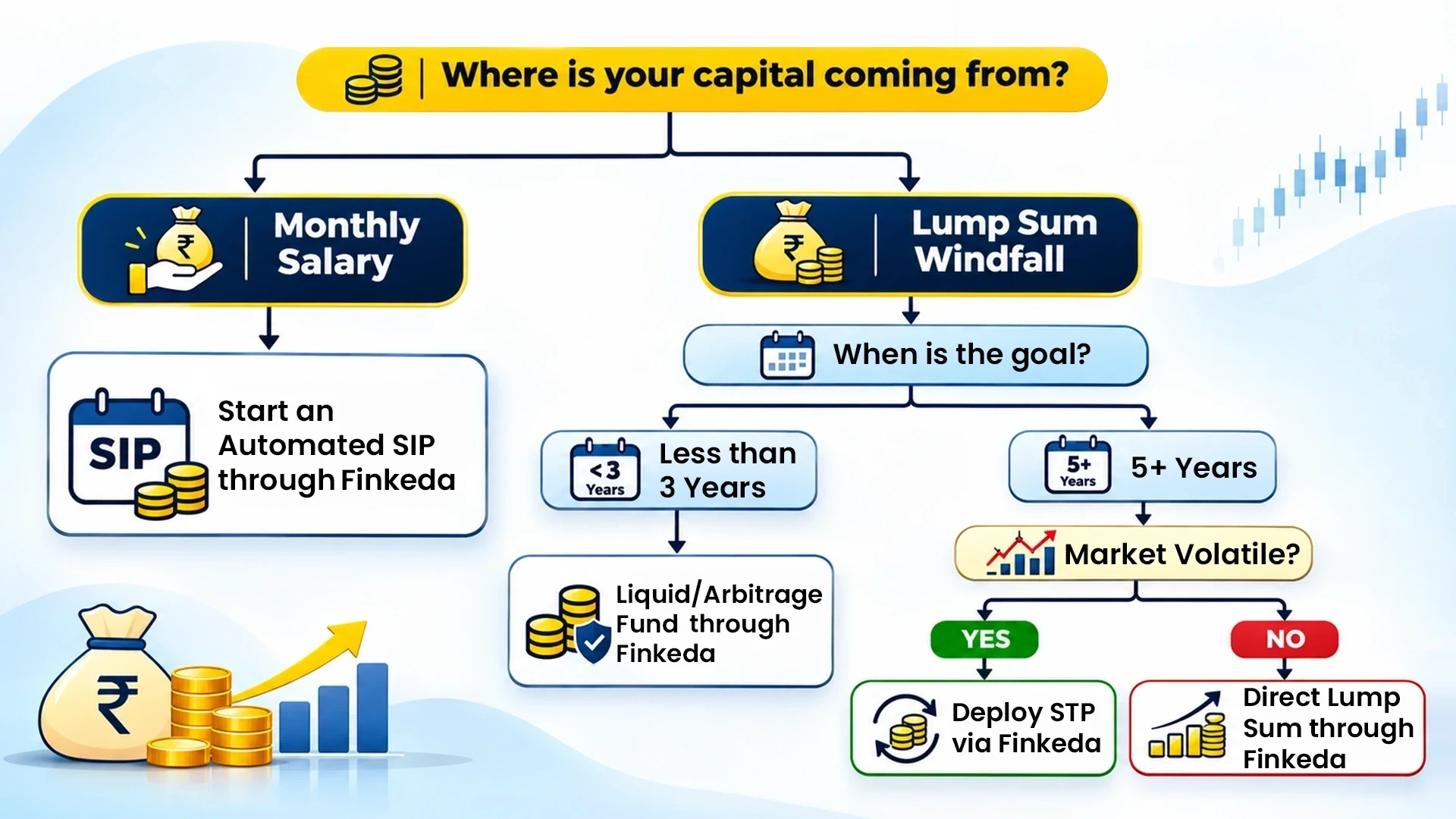
If you would like a quick way to decide, work through the following steps in order.
Start by asking whether the money is a regular monthly surplus or a one-time amount. If it is a monthly surplus, set up a SIP, choose an amount you can sustain, and consider an annual step-up. If it is a one-time amount, move on to the next step.
Next, ask when you will need the money. If you will need it within three years, keep it in debt or liquid funds and do not place it in equity. If you will not need it for at least five to seven years, continue to the next step.
Then ask how you would feel if the investment fell by 20 to 25 percent soon after you invested. If you would stay calm and keep going, a lump sum in a suitable equity or hybrid fund is a reasonable choice. If you would feel anxious or tempted to sell, use an STP over six to twelve months.
Because your fund category matters more than the mode of entry, keep short-term capital parked in low-volatility debt funds while directing long-term wealth into equities. Revisit this asset allocation once a year: as your income, goals, and risk tolerance shift, your balance between capital preservation and growth should adjust alongside them.
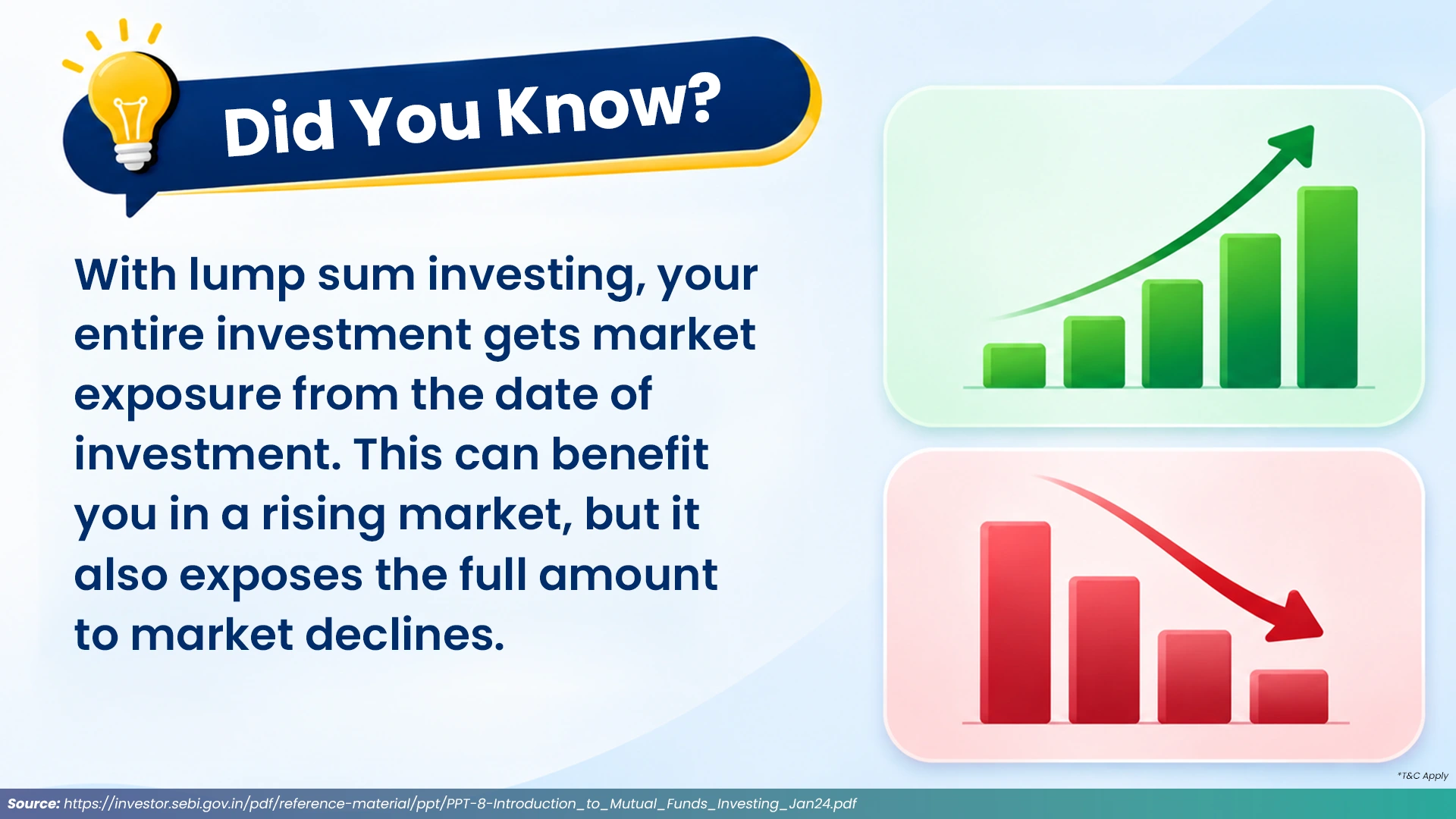
The debate between SIP and lump-sum investing assumes one method must outperform the other, but each serves a distinct cash-flow reality. A lump sum maximizes market exposure when capital is readily available upfront, whereas a SIP mitigates timing risk and aligns naturally with recurring cash flows.
Rather than treating them as mutually exclusive, investors often combine both: running consistent periodic contributions while deploying surplus windfalls when available.
As you plan for 2027, execution matters more than predicting market movements. Select a sustainable commitment, align your fund choices with your time horizon and risk appetite, rebalance annually, and allow compounding to do the heavy lifting over time.
SIP invests a fixed amount at regular intervals (monthly/quarterly) to average costs over time, while a lump sum invests your entire capital in a single transaction on day one.
Choose a SIP if investing from monthly salary or if market levels feel uncertain; choose a lump sum (or an STP over 6–12 months) if you have idle windfall cash for a 5+ year horizon.
Mathematically, lump sum generates higher returns in rising markets because 100% of capital compounds from day one; practically, SIP delivers better real-world outcomes for most investors by eliminating panic and matching income cycles.
When you have a regular monthly income, lack idle capital, want automated financial discipline, or seek to avoid investing a large sum at a market peak.
When you receive a cash windfall (bonus, asset sale, maturity payout), enter the market after a sharp correction, or deploy capital into low-volatility liquid/debt funds.
Volatility helps SIP by automatically purchasing more units at lower prices during market dips, while volatility increases short-term risk for lump sum by exposing the entire balance immediately.
Build a 3–6 month emergency fund first, invest in equity only for goals 5+ years away, gauge your emotional tolerance for market drops, and pick an amount you can continue uninterrupted.
Disclaimer: Investments in securities market are subject to market risks, read all the related documents carefully before investing. Finkeda (IKEDA LIMITED) is an Authorised Partner of AXIS SECURITIES LIMITED, SEBI Registration No. INH 000000297, AMFI-registered Mutual Fund Distributor, ARN-64610 NSE – BSE – MCX AP Registration No. CM-AP2064014403 / FO-AP2064014403.
Statutory & Regulatory Disclosures
Share :
Like:
0