
Sep. 09, 2026

12 Min read

Insurance

Share :


Single-trip travel insurance is a specialised policy designed to protect an individual for the duration of a particular journey, whether it is undertaken for leisure, business, or education. Unlike annual or multi-trip policies, it is issued for a defined period, commencing from the date of departure and concluding upon the traveller’s return. This article provides a detailed examination of the meaning, features, benefits, eligibility criteria, coverage inclusions, exclusions, cost determinants, and claim process associated with single-trip travel insurance, along with practical guidance on selecting the most suitable plan for domestic and international travel requirements.
For occasional travelers taking a specific domestic or international trip, single-trip travel insurance provides dedicated, time-bound financial security without the ongoing cost of an annual plan. This detailed guide breaks down how short-term coverage mitigates risks from emergency medical care, trip cancellations, lost luggage, and travel disruptions during a single journey. By outlining key policy inclusions, standard exclusions, cost factors, and the step-by-step claims process, this article provides a practical framework to help you evaluate coverage options and select the right plan with confidence.
Travelling, whether across international borders or within one’s own country, carries an inherent element of uncertainty. Flight delays, sudden medical emergencies, misplaced baggage, and unexpected cancellations can disrupt even the most carefully planned itinerary and, in the absence of adequate protection, can result in considerable financial strain. Single-trip travel insurance exists precisely to address these uncertainties, offering comprehensive financial protection for the entire duration of a single, specific journey, from the moment of departure to the point of return.
This form of coverage has gained substantial relevance recently, as outbound tourism from India continues to grow steadily and more individuals are travelling abroad for leisure, work, and study than ever before. For those undertaking a one-time trip, a single trip policy provides a tailored, cost-effective, and administratively simple alternative to an annual travel insurance plan, which is generally more appropriate for frequent flyers.
Single-trip travel insurance is a policy that provides coverage for one specific journey, beginning on the departure date and concluding at the end of the trip, typically upon the traveller’s return to their home country or place of residence. It is particularly suited to individuals who travel infrequently and require protection for a clearly defined period rather than ongoing, year-round coverage. The policy generally covers a wide range of contingencies, including medical emergencies, hospitalisation, trip cancellations or interruptions, baggage-related losses, travel delays, and third-party liability.

Consider, for instance, a traveller journeying from India to a foreign destination who encounters a substantial flight delay of several hours, resulting in the late arrival of checked baggage. Expenses incurred during this period, such as meals, temporary accommodation, and essential toiletries, may be reimbursed under a single trip insurance plan, thereby reducing the financial burden of an unforeseen disruption. Similarly, should the same traveller require hospitalisation due to a sudden illness while abroad, the policy would typically extend cover for the associated medical costs, subject to the terms of the plan.
It is worth noting that single-trip travel insurance can be purchased for both outbound international journeys and domestic trips within India, with the scope of coverage and premium varying according to the destination, duration, and traveller profile.
A single-trip holiday insurance plan typically includes the following features, each addressing a distinct category of travel-related risk:
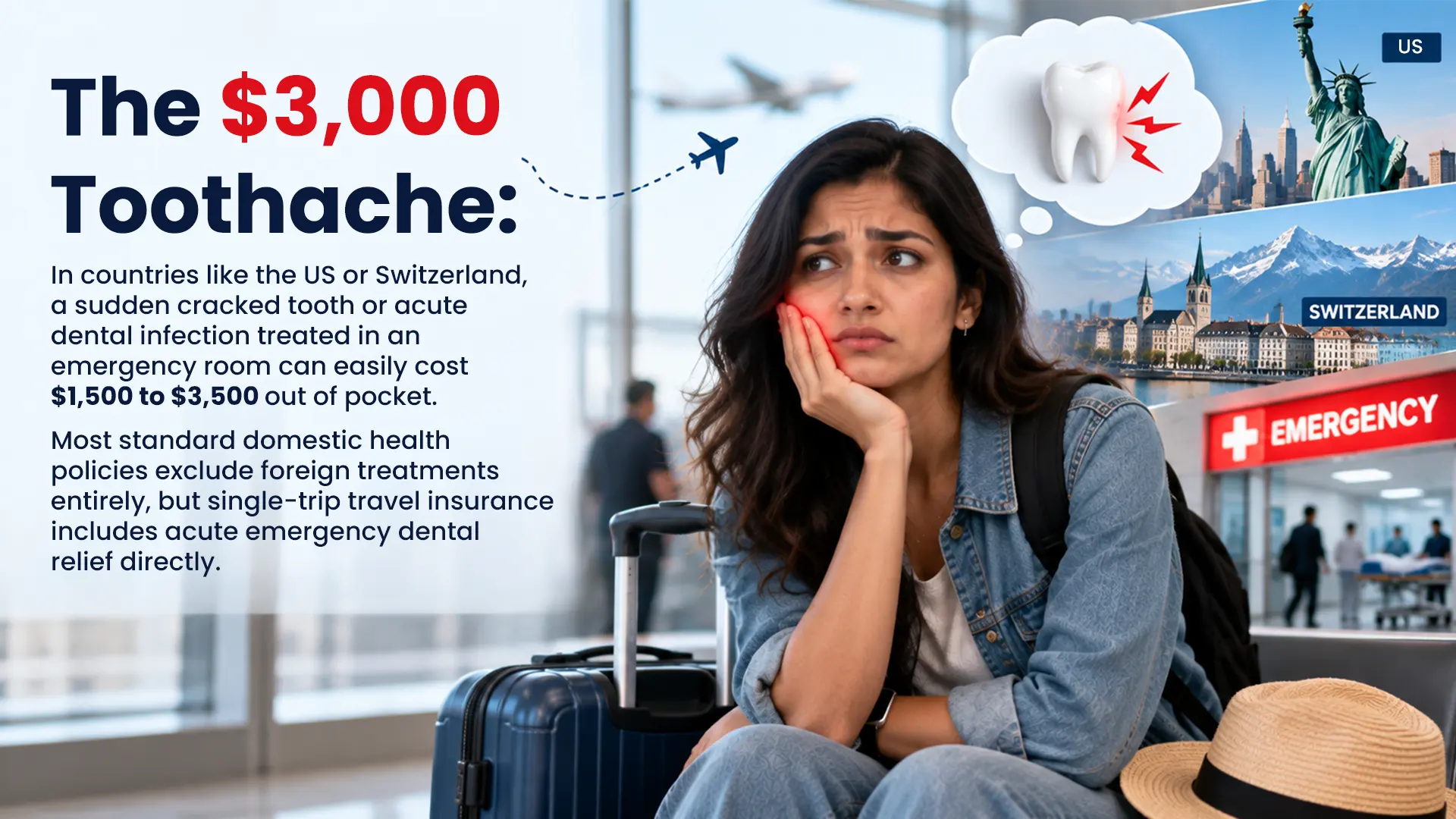
The advantages of opting for single-trip insurance extend across financial, logistical, and emotional dimensions of travel:
Together, these benefits contribute to a more secure, predictable, and stress-free travel experience, making single-trip insurance a practical choice for occasional travellers of all ages and for all travel purposes.
Single travel insurance, whether for a one-way journey or a round trip, plays a critical role in safeguarding travellers against unforeseen expenses that could otherwise disrupt both the trip and their personal finances. Medical emergencies, flight delays, trip cancellations, and lost baggage can all result in significant financial strain if left uninsured, particularly in destinations where healthcare costs are considerably higher than in India.

A single trip policy provides practical assistance in unfamiliar surroundings, including access to emergency helplines, cashless hospital networks, and claims support, and offers reassurance that unexpected events will not derail the overall travel experience. This is particularly valuable for first-time international travellers, students heading abroad for education, business travellers attending time-sensitive engagements, and families travelling together, as it allows them to focus on their vacation or business commitments without undue concern over potential mishaps. In the absence of such a policy, travellers may be required to bear the full cost of medical treatment, rebooking, or emergency evacuation out of pocket, which can amount to substantial sums depending on the destination and the severity of the situation.
The eligibility requirements for single-trip travel insurance are generally straightforward, though they may vary to some extent between insurers:
A single trip insurance policy generally extends coverage across the following areas, each addressing a specific category of travel risk:
While the scope of coverage is broad, most single-trip travel insurance policies carry certain standard exclusions, and it is important for travellers to review these carefully before purchase:

Given that single trip policies account for a substantial share of the travel insurance market, it is worthwhile to evaluate the following factors carefully before purchase:
Single-trip travel insurance is best suited to occasional travellers undertaking a specific journey, whereas frequent travellers may find greater value in an annual, multi-trip policy that covers unlimited journeys within a year.
It is advisable to review any existing insurance policies, including health insurance or credit card-linked travel cover, before purchase to avoid unnecessary duplication of cover and premium costs.
The extent of coverage should correspond to the nature of the trip; adventure-orientated travel warrants more comprehensive protection with relevant add-ons, while a relaxed holiday may require a more basic plan with standard inclusions.
Full and accurate disclosure of any pre-existing health conditions is essential to ensure complete coverage and to avoid disputes or claim rejection at a later stage.
Securing insurance well before booking flights ensures that trip cancellation coverage begins promptly, protecting against disruptions that may arise even before the date of departure.
It is important to examine the overall sum insured as well as any sub-limits applicable to specific categories, such as baggage loss or trip delay, to ensure the coverage amount is adequate for the intended destination.
Checking whether the insurer maintains a network of cashless hospitals at the destination can significantly ease the process of accessing medical treatment during an emergency.
In practical terms, single-trip travel insurance serves as a financial safety net for a single journey, generally covering:
Several interrelated factors influence the premium for a single trip insurance plan:
The length of the journey and the cost of medical care at the destination have a direct bearing on premium amounts, with longer trips and destinations known for higher healthcare costs, such as the United States or parts of Europe, typically attracting higher premiums than shorter trips to more cost-effective destinations.
Younger travellers generally benefit from lower premiums, as advancing age is associated with increased health risks and, consequently, higher insurance costs. Senior citizens may be required to undergo medical screening in certain cases.
Plans offering broader protection, such as trip cancellation for any reason, higher medical sum insured, or extensive add-ons, tend to carry higher premiums in proportion to the scope of benefits provided.
Pre-existing medical conditions can meaningfully affect premium calculations, as insurers factor in the likelihood of medical claims arising during the trip and may apply a loading or specific exclusion accordingly.
Family or group plans covering multiple travellers on the same itinerary may offer more economical per-person rates than individual policies purchased separately.
Understanding the claims process in advance can help ensure a smoother experience in the event of an actual emergency:
Single-trip travel insurance serves as a dependable and comprehensive safeguard for individuals undertaking a specific journey, whether for domestic travel or an international holiday. With coverage spanning medical emergencies, trip cancellations, baggage-related losses, travel delays, and personal liability, it offers a practical and cost-effective solution for occasional travellers. By understanding the features, eligibility requirements, coverage inclusions, exclusions, cost determinants, and claims process outlined above, travellers are better positioned to select an appropriate policy and undertake their journey with confidence, knowing that unforeseen disruptions will not lead to unmanageable financial burdens.
Single trip travel insurance is a policy that provides coverage for one specific journey, from departure to return, protecting against risks such as medical emergencies, trip cancellations, baggage loss, travel delays, and personal liability for the duration of that particular trip alone.
It offers focused financial protection against unforeseen events during a single journey, such as medical emergencies, flight delays, or lost baggage, without requiring the ongoing commitment or higher cost of an annual policy, making it a practical and economical choice for those travelling occasionally rather than throughout the year.
The policy reimburses or directly settles medical treatment and hospitalisation costs incurred abroad, including emergency evacuation where required; compensates for baggage that is lost, stolen, or delayed in transit; and covers non-refundable expenses, such as prepaid flights and accommodation, when a trip is cancelled or interrupted due to qualifying reasons like illness, injury, or natural calamity.
Single trip insurance covers one specific journey for its defined duration and is generally more economical for occasional travellers, while multi-trip or annual insurance provides continuous coverage for multiple journeys undertaken within a year, making it more suitable and cost-effective for frequent travellers who take several trips annually.
Selecting a suitable plan involves evaluating the destination and associated healthcare costs, trip duration, overall sum insured and sub-limits, specific inclusions such as medical and baggage cover, exclusions and pre-existing condition clauses, availability of cashless hospital networks, and a comparison of premiums across insurers to identify the policy that best aligns with individual travel needs and budget.
For domestic travel insurance, a single trip policy typically covers medical emergencies, baggage loss, and trip cancellation within the country, while for international trip insurance, it additionally extends to emergency evacuation, repatriation, and a higher medical sum insured suited to overseas treatment costs, ensuring a secure and well-supported travel experience regardless of the destination chosen.
Standard T&C apply.
*Insurance is the subject matter of solicitation. For more details on benefits, exclusions, limitations, terms, and conditions, please read the sales brochure/policy wording carefully before concluding a sale.
*Claims are subject to terms and conditions set forth under the travel insurance policy.
Share :
Like:
0