
Oct. 17, 2026

8 Min read

Insurance

Share :


Any Indian family feels a sense of pride in buying a brand new car. But driving your new car on public roads can expose you to significant financial and legal risks if you don’t have adequate insurance coverage. These policies are often sold right in the invoice with arbitrary fees tacked on, taking advantage of the customer’s purchase momentum at the dealership. Take independent control of your motor cover and make sure that your vehicle is protected against road accidents, heavy monsoon floods, vandalism, and without overspending on insurance.
This in-depth guide helps first-time vehicle owners understand the fundamentals of auto insurance by breaking down the essential mechanics involved. You will learn how to calculate the actual insurable worth of your vehicle, identify high-value add-on riders, and master strategic renewal tactics. You will also understand the difference between basic mandatory insurance and broader protection for your car. If you arrange your auto insurance through Finkeda, you can be confident that your policy will be completely transparent, that your household finances will be protected, and that your claims will be processed smoothly and without any hassle whenever an emergency occurs.
Before jumping into add-ons and policy terms and conditions first-time buyers must understand the basic architecture of Indian motor insurance. A policy is not a one-size-fits-all product; the policy framework you select determines exactly what protection you have, what you will pay out of pocket for accidents, and your annual premium. Driving without third-party liability is an offence under the Motor Vehicles Act, but statutory cover alone will not repair even a single scratch on your vehicle.
The side-by-side comparison below lays out which tier works best for your vehicle’s age, how you use it, and your financial risk profile:
| Factor | Third Party Only Cover | Standalone Own Damage Cover | Comprehensive Cover |
| Legal Obligation | Mandatory under the Motor Vehicles Act | Requires an active third-party policy | The compulsory statutory third-party element was included |
| Damage to Your Automobile | No monetary compensation | Covers accidental impact, theft, and natural disasters | Maximum protection against accidents, weather disasters, and theft |
| Damages to Third Parties | Bodily injury, loss of life, and property liabilities | Not covered under this individual policy framework | Bodily injury, loss of life, and property liabilities |
| Add-on Compatibility | No optional riders | Supports riders like Zero Depreciation | Supports all riders, engine guards, and roadside assistance |
| Ideal For | Cars that depreciate in value as they get older | Owners of vehicles with active long-term third-party cover | New personal vehicles and first-time buyers |
All motorised vehicles on public roads in India must have valid insurance as required by law. A third-party policy covers only legal liabilities arising from bodily injury, death, or property damage caused to outsiders; it does not cover any damage to your vehicle.
A comprehensive policy will protect your asset while fulfilling all legal mandates simultaneously. Finkeda assists you to provide comprehensive car insurance packages designed to protect both your car and your wallet at the same time.
| Aspect | Details |
| Definition | The maximum amount the insurer may pay if your car is stolen or declared a total loss, subject to the policy terms and conditions. |
| How It Is Decided | Manufacturer’s listed ex-showroom price minus statutory annual depreciation schedules laid down by insurance regulators. |
| IDV Reduction Effect (On Premium) | Yields a small, marginal reduction in your annual premium only. |
| IDV Reduction Effect (On Claim) | Significantly reduces your payout if you face a major claim; the financial loss can far outweigh the minor premium savings. |
| Applying Through Finkeda | The IDV is fixed in line with the actual market benchmark for the vehicle, ensuring a fair valuation. |
Disclaimer: Setting an artificially lower IDV to cut down on upfront premiums leaves you severely under-compensated in the event of total vehicle loss or theft. Always verify that your vehicle’s IDV reflects its authentic regulatory value.
| Add-On Cover | What Standard Policies Do (Problem) | How the Add-On Protects You (Benefit) | Best Suited For |
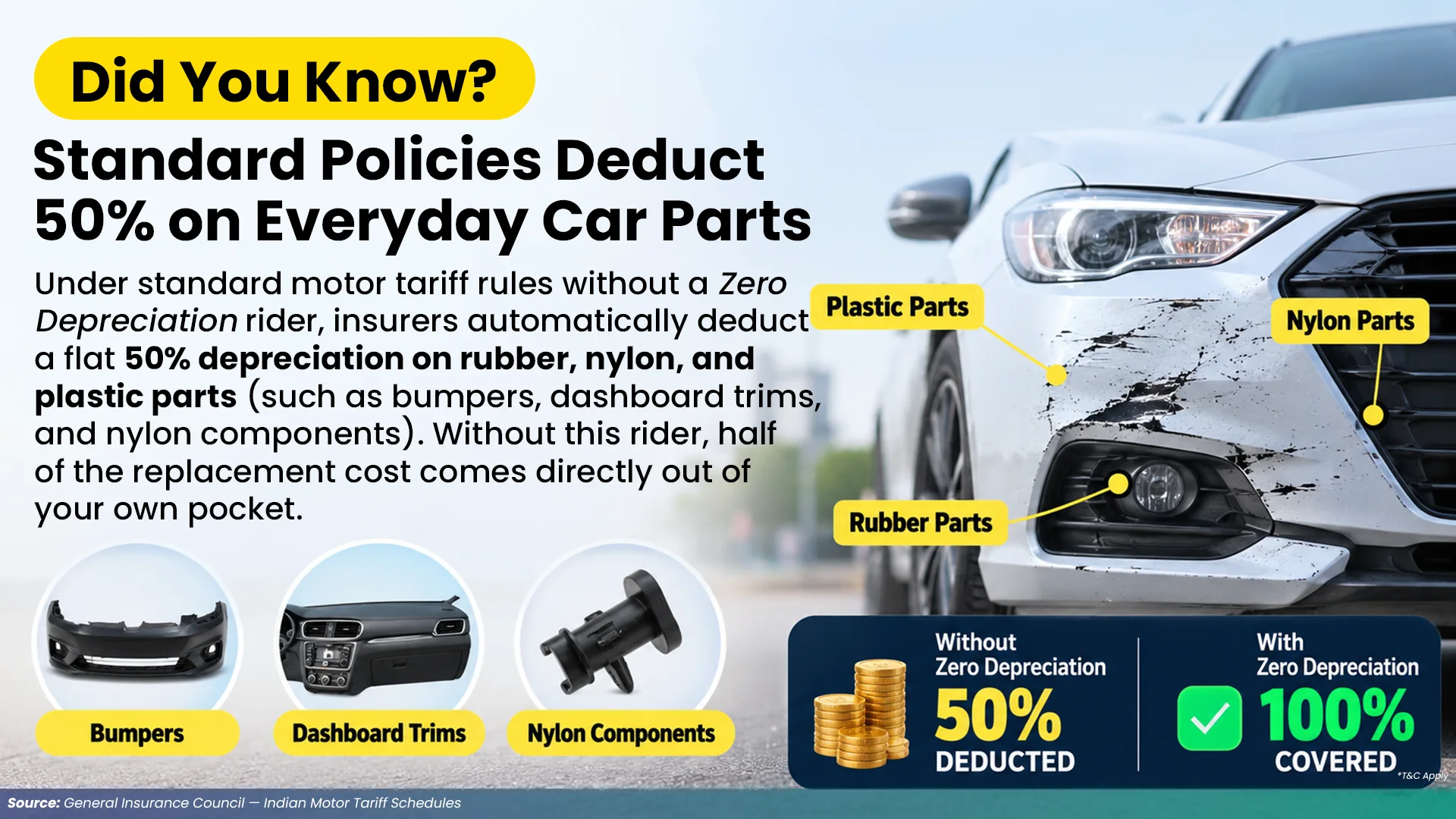
| Zero Depreciation | Heavy depreciation deductions (up to 50%) are applied to plastic, rubber, nylon, and metal replacement parts. | Eliminates depreciation deductions completely; the insurance company pays the full replacement cost of parts. | Brand new vehicles (up to 5 years old) and first-time buyers. |
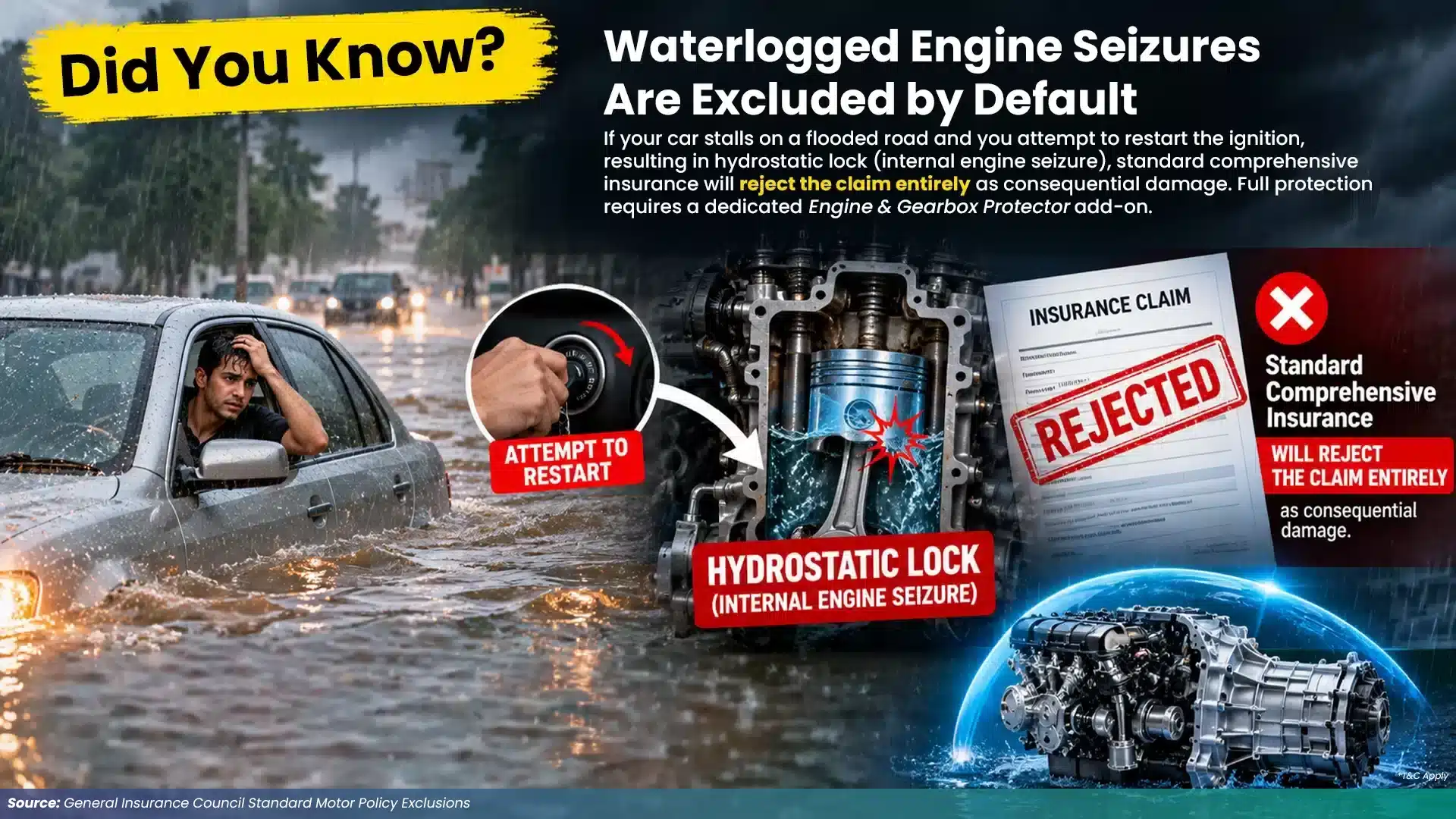
| Engine & Gearbox Protector | Hydrostatic lock or internal engine damage resulting from waterlogging is excluded under regular own-damage cover. | Covers the cost of repairs and replacements for damage arising from water ingress during seasonal urban flooding. | Monsoon-prone areas, low-lying cities, and premium or automatic cars. |
| Return to Invoice (RTI) | In the case of total loss or theft, the insurer pays only the depreciated Insured Declared Value (IDV). | Covers the full difference between the depreciated IDV and your original on-road purchase price (including taxes and registration). | Brand new cars during their first 1 to 3 years of purchase. |
| Deductible Type | Definition & Nature | Cost Range / Threshold | Impact on Annual Premium | Who Pays & When |
| Compulsory Deductible | Mandatory fee fixed by the Indian Motor Tariff under insurance regulations. |
|
None (standard regulatory baseline included across all policies). | You pay this fixed amount out of pocket on each claim; the insurer covers the remaining balance. |
| Voluntary Deductible | Optional co-pay limit chosen by the vehicle owner at the time of purchase. | Ranges from Rs 2,500 to Rs 15,000+ over and above the compulsory fee. | Reduces your upfront premium (the higher the voluntary deductible, the higher the discount). | You pay this extra amount out of pocket alongside the compulsory deductible whenever a claim is settled. |
Disclaimer: A higher voluntary deductible lowers your annual renewal price, but forces a direct, unplanned out-of-pocket payment every single time an accident occurs. First-time owners should avoid committing to steep voluntary excess limits.
The No Claim Bonus (NCB) is a cumulative discount that you receive year-on-year for not making any claims during a policy period. The benefit starts at 20% after the first claim-free year and increases up to 50% after five consecutive claim-free years. Because the NCB is attached to you as a driver rather than the car itself, you can easily transfer this accumulated discount to a new vehicle whenever you decide to upgrade.
| Consecutive Claim-Free Tenure | Accrued NCB Discount on Own Damage |
| 1 Year | 20% |
| 2 Years | 25% |
| 3 Years | 35% |
| 4 Years | 45% |
| 5 Years (Maximum) | 50% |
Disclaimer: An accrued No Claim Bonus completely lapses if a policy remains unrenewed past the 90-day grace period from its expiry date. Additionally, filing even one small accidental claim resets this discount to zero on a basic policy.
The true value of an insurance policy depends largely on the efficiency of its claim settlement process. Make sure the insurer you select maintains active cashless tie-ups with authorised workshops and service stations in your city. In a cashless claim, the network garage sends the repair bill directly to the insurer, requiring you to pay only your mandatory deductibles and consumable costs. Always verify that your prospective insurance provider holds a verified Claim Settlement Ratio (CSR) above 95%.
If you file a claim for small scratches costing between Rs 1,000 and Rs 1,500, your accrued No Claim Bonus is completely wiped out, leading to a much higher renewal premium next year. Additionally, failing to declare after-market modifications such as CNG kits or alloy wheels gives insurers legitimate grounds to reject your claim. Always keep active digital copies of your policy, driving licence, pollution certificate (PUC), and registration certificate (RC) updated inside DigiLocker.
Disclaimer: Unendorsed modifications, expired PUC certificates, or failure to report accidents within the insurer’s mandated intimation window (usually 24–48 hours) can lead to outright claim repudiation.
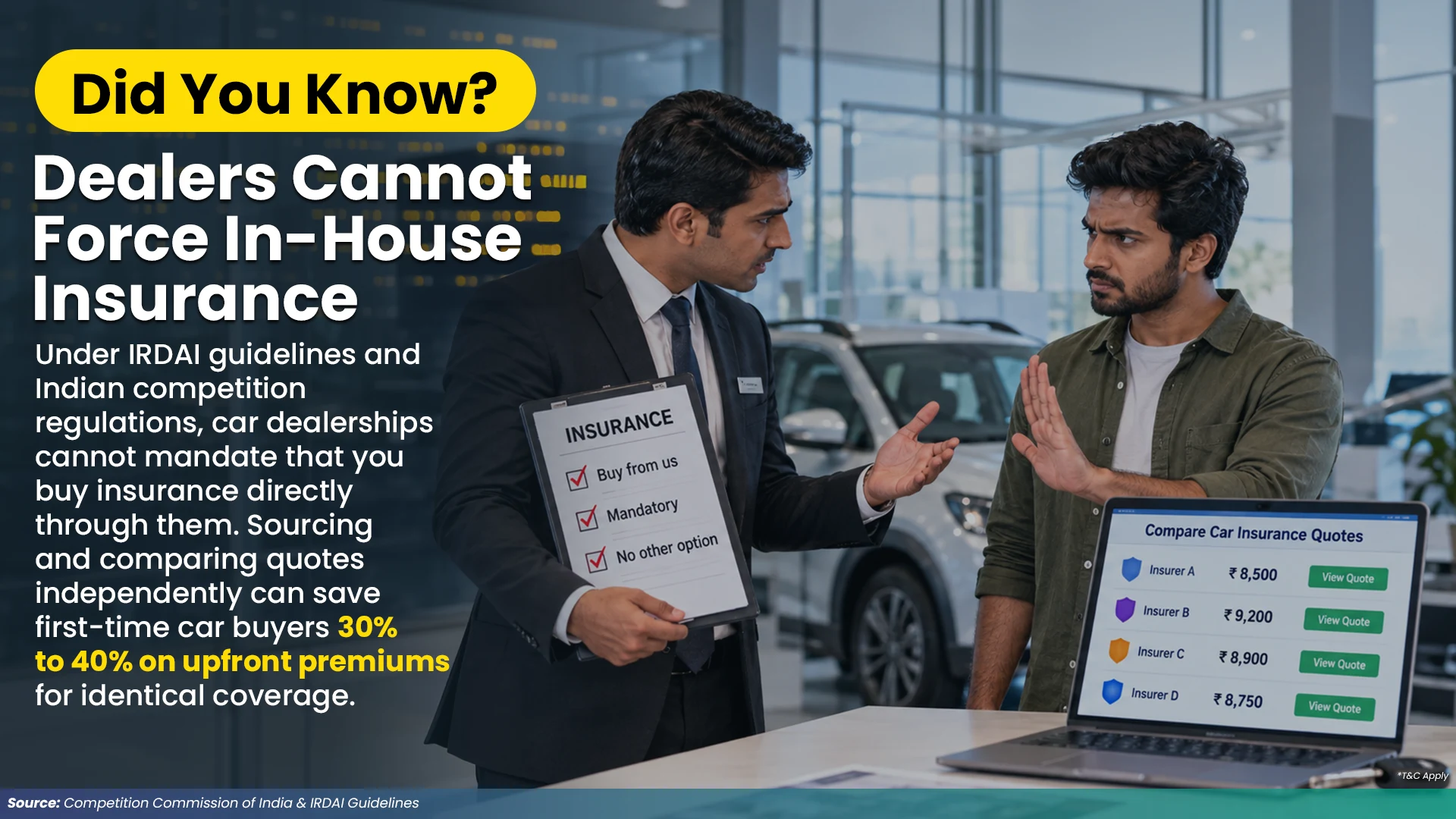
Beginners must understand the difference between third-party and comprehensive covers, ensure their Insured Declared Value is calculated accurately, and compare prices independently instead of accepting dealership insurance quotes blindly.
A comprehensive car insurance policy paired with a zero depreciation add-on is the best choice for first-time car buyers because it covers both third-party liabilities and your accidental repair costs.
Car insurance covers third-party bodily injury, accidental death, third-party property damage, own-damage repair costs from collisions, vehicle theft, fire, and natural calamities like floods and earthquakes.
Car insurance premiums are determined by the vehicle’s engine cubic capacity, the age of the car, the insured declared value, the geographic registration zone, selected add-on covers, and your accumulated No Claim Bonus.
Insured Declared Value (IDV) is the sum insured of your car for Total Loss or Constructive Total Loss (CTL) claims. It is generally calculated based on the manufacturer’s listed selling price of the vehicle at the start of the policy or renewal, adjusted for applicable depreciation.
Beginners should consider Zero Depreciation, Engine and Gearbox Protector, Return to Invoice, 24×7 Roadside Assistance, and Consumables Cover to avoid heavy out-of-pocket repair bills.
First-time buyers should avoid accepting overpriced dealer policies without comparing options, choosing an artificially low IDV, filing claims for minor cosmetic scratches, and allowing the policy to lapse past the 90-day grace period.
Disclaimer: Insurance is a subject matter of solicitation. The information provided in this guide is for educational and informational purposes only and does not constitute formal legal or financial underwriting advice. Policy terms, conditions, add-on availability, deductibles, and settlement criteria vary across insurers and are subject to Indian Motor Tariff regulations and the respective insurance company’s underwriting guidelines. Please read the policy sales brochure and contract wordings carefully before concluding a purchase.
This blog is intended solely for educational and informational purposes. Content reflects data at time of publication and may not accurately reflect current premiums, terms, or regulations. Readers are encouraged to confirm the accuracy and relevance of the data before making any significant decisions.
Share :
Like:
0