
Sep. 23, 2026

11 Min read

Investments

Share :


Retirement planning is a continuous journey to protect your lifestyle from market fluctuations and rising inflation.
A successful strategy relies on two distinct stages:
First, aggressively grow your investments when your income is at its peak.
Second, shifting focus to wealth preservation as you get closer to your retirement date
Finkeda brings you this complete guide to help you analyze structured investment vehicles like Unit Linked Insurance Plans (ULIPs), index funds, and annuity options; understand key policy nuances; and implement a personalized asset-allocation strategy that delivers you real financial freedom. With Finkeda you are fully in control of your retirement plan from day one with clear and actionable steps, experienced support by call and email, and dedicated financial instruments.
This complete guide goes over every step of planning for retirement in great detail so that people can build, protect, and grow their wealth after they retire.
In addition to savings guidance, this guide also includes details on creating long-term wealth, asset allocation between market-linked and fixed-income choices, and practical risk management. Readers will learn how compounding can exponentially magnify early investments, how to estimate future living costs accurately under long-term inflationary pressures, and how to use modern pension tools effectively, such as Unit-Linked Insurance Plans (ULIPs), government-backed instruments, and annuity options, to create dependable, lifelong income streams.
The guide also outlines the main financial traps to avoid, how to ring-fence retirement assets against health issues, and practical steps to follow to move from wealth development to stable income generation. Finkeda provides you with practical guidance, specialized expert support by phone and email, and tracking tools to help you reach full financial freedom with less worry.
 Source: IRDAI – Evolution of Insurance | Figure: 1
When you’re years away from retirement, it might seem like a distant milestone, which is why so many people end up putting off the conversation with themselves about how they’ll actually support those years. The fact is a comfortable retirement rarely comes by accident. That’s what happened when someone sat down and thought through their figures and put together a retirement plan that might expand consistently over time. When you search “how to save for retirement” at midnight, this tutorial is for you.

Finkeda helps people work toward their retirement plans over time, and you’ll see references to it throughout this article. Call Finkeda for help with complicated mathematical calculations.
As life expectancy increases and the cost of living continues to rise, securing your financial future requires earlier and more strategic planning. Inflation erodes the value of idle assets, medical costs continue to climb, and employment pension plans may not be sufficient to sustain a comfortable level of living once you retire. Combine those two considerations, and saving for retirement is no longer a luxury but a must. If you make it a priority now, you will have more time to think about it later.
Here’s a simple way to visualize how big the difference is between starting early and starting late.
| Start Age | Monthly Contribution | Years of Investment | Approximate Corpus by 60 (8% p.a. growth) |
| 25 | Rs 5,000 | 35 | Approx. Rs 1.13 Cr |
| 35 | Rs 5,000 | 25 | It’s about Rs 47.5 lakh. |
| 45 | Rs 5,000 | 15 | Rs 17.4 Lakhs approx. |
These are only examples, but the same principle applies whatever the specific numbers. The sooner you start, the less you have to stretch to accomplish the same goal later.
Note: The corpus figures are illustrative projections based on an assumed 8% annual growth rate. Actual returns are not guaranteed and may vary depending on the investment and market conditions.
Finkeda will review the calculations for your age and monthly contribution if you wish to create your own table.
The most common piece of advice in retirement planning is to start early and let compounding work for you, and it is repeated so often just because it works. But when you start saving in your 20s or early 30s, even little contributions each month have decades to compound. The difference between starting a retirement savings plan at age 25 vs. age 40 isn’t just fifteen years of contributions; it is fifteen years of compounding that the early starter gets and the late starter simply can’t get back.
Here’s a step-by-step technique to really apply this information instead of just knowing it in theory.
Step 1: Please write out your current age and your expected retirement age.
Step 2: Call Finkeda with these two figures and what you are able to put aside each month, and they can help you visualize what your final corpus might look like.
Step 3: Choose a reasonable amount to save today, not a huge amount that you’ll probably forget about in a few months.
Step 4: Record this so it’s tracked along with your other financial targets.
Step 5: Check back every couple of months to check how your progress is building up. Because often times it’s that number growing that keeps people constant over the long term.
If you don’t know exactly how much those extra years are worth, it’s worth having a proper projection instead of guessing. Finkeda’s team can walk you through your current age, predicted retirement age, and monthly contribution over a call to show you how your corpus could increase. This makes the abstract idea of compounding feel a lot more tangible and a lot more compelling.
Many people don’t save enough for retirement because they haven’t worked out how much they’ll need, or they steer clear of the issue completely because the math is too complicated. The answer to both questions is the same: Establish a broad goal. To establish a broad goal, consider how much you want to spend each month in retirement, your current age, and the number of years you have left to save.
When you break the process down into separate steps, it becomes a lot less daunting.
Step 1: Write down all your monthly expenses, including your rent, food, medical care, travel, and lifestyle.
Step 2: Work out which of these costs are likely to go up (healthcare, for example) and which are likely to go down (commuting, for example).
Step 3: Take an estimated inflation rate of 6 to 7 percent a year in India and see where these expenditures can go when you retire.
Note: The inflation rate used here is an illustrative assumption. Actual inflation may vary over time and across expenses.
Step 4: Call Finkeda and tell them your projected monthly amount, and they will help you figure out your total need.
Step 5: Begin with your goal for the corpus and work backward to determine how much you need to save each month. Then, be honest with yourself and assess how much you can actually set aside now.

Disclaimer: This content is for general educational and informational purposes only. The illustration is based on assumed withdrawal, inflation and return rates and is not a guaranteed outcome. Actual results may vary depending on investment performance, inflation, expenses, taxes and individual circumstances. Please consider your financial goals and consult a qualified financial professional before making investment decisions.
Many financial advisors recommend that you try to replace 70 to 80 percent of your present monthly income, adjusted for inflation, when you retire.
Note: The 70–80% figure is a general planning guideline, not a fixed requirement. Actual retirement needs depend on individual expenses, lifestyle, inflation and other financial resources.
You don’t need to get to this exact number on your first attempt. Finkeda makes it simple to review and amend your retirement plan annually as your income and expenses change. That means the aim is going to be a realistic goal and not a never-changing estimate.
It’s not a good idea to put all of your retirement or pension plans in one basket, because the rules could change or the system might not work. Diversify your plan to save for retirement by including a number of different options, each of which has its own purpose.
| Scheme | Risk Rating | Lock In, Normal | Best for |
| Provident Fund of Employer | Poor | Until retirement | Regular employees desiring stable guaranteed growth |
| Public Provident Fund (PPF) | Low | 15-year tenure / maturity period | Tax-free returns for the conservative investor |
| System | Moderate to High | Partial exit 60 | Those who don’t mind a bit of market exposure for more growth |
| Insurance with retirement plans | Low to Mid | Varies by plan | People who want a guaranteed monthly paycheck later in life |
If you are new to retirement plans in India, it is a good idea to compare several pension plans before making a final decision. Before parting with any cash, ensure you understand the lock-in period of the options, estimated returns, flexibility of emergency withdrawal, and any tax benefits.
Note: Risk levels, returns, lock-in periods, tax treatment and other features may vary by product, scheme and applicable rules. Check the latest official terms before investing.
Here are the instructions to follow when constructing this mix.
Step 1: Please list all schemes you are currently contributing to, including any employer deductions.
Step 2: Add each scheme to Finkeda so that all your pension schemes and pension plans are in one dashboard, rather than spread across hundreds of apps and paper statements.
Step 3: Review the percentage of your total retirement funds in reduced-risk options versus growth opportunities.
Step 4: Make this mix fit your age. In general, you should lean toward growth in your 20s and 30s and then slowly move toward stability as you get closer to retirement.
Step 5: If you need help working out what the correct balance is, you can call Finkeda and discuss your allocation with their experts.
The number one reason retirement plans fail is not poor investment selections; it’s just inconsistency. Life becomes hectic. Sudden bills pop up. And the monthly deduction to your retirement account is discreetly missed more often than it should be. Automating your donation means you don’t have to think about it.
Step 1: Set up a monthly transfer for payday, before you have a chance to spend it on something else.
Step 2: Log this recurring donation in Finkeda so you can track it alongside your other financial targets, all in one location.
Step 3: Set a simple reminder on your phone or calendar so you don’t miss a contribution.
Step 4: Don’t assume the transfer is automatic. Check in about once a month to see if it went through as planned.
Step 5: If your income increases, increase the amount that you contribute to Finkeda so that your savings rate increases with your salary instead of being flat for years.
By tracking these contributions with financial planning tools in conjunction with your other financial objectives, you’ll never have to sift through several accounts and spreadsheets each month to find out how close you are to your target.
You don’t set up a retirement plan and then let it sit there for the next thirty years. Your income will be different. Your obligations to your family will shift. Inflation will slowly drive up the expense of the lifestyle you are planning. A number that looked good 10 years ago may be far from what you actually need by the time you retire.
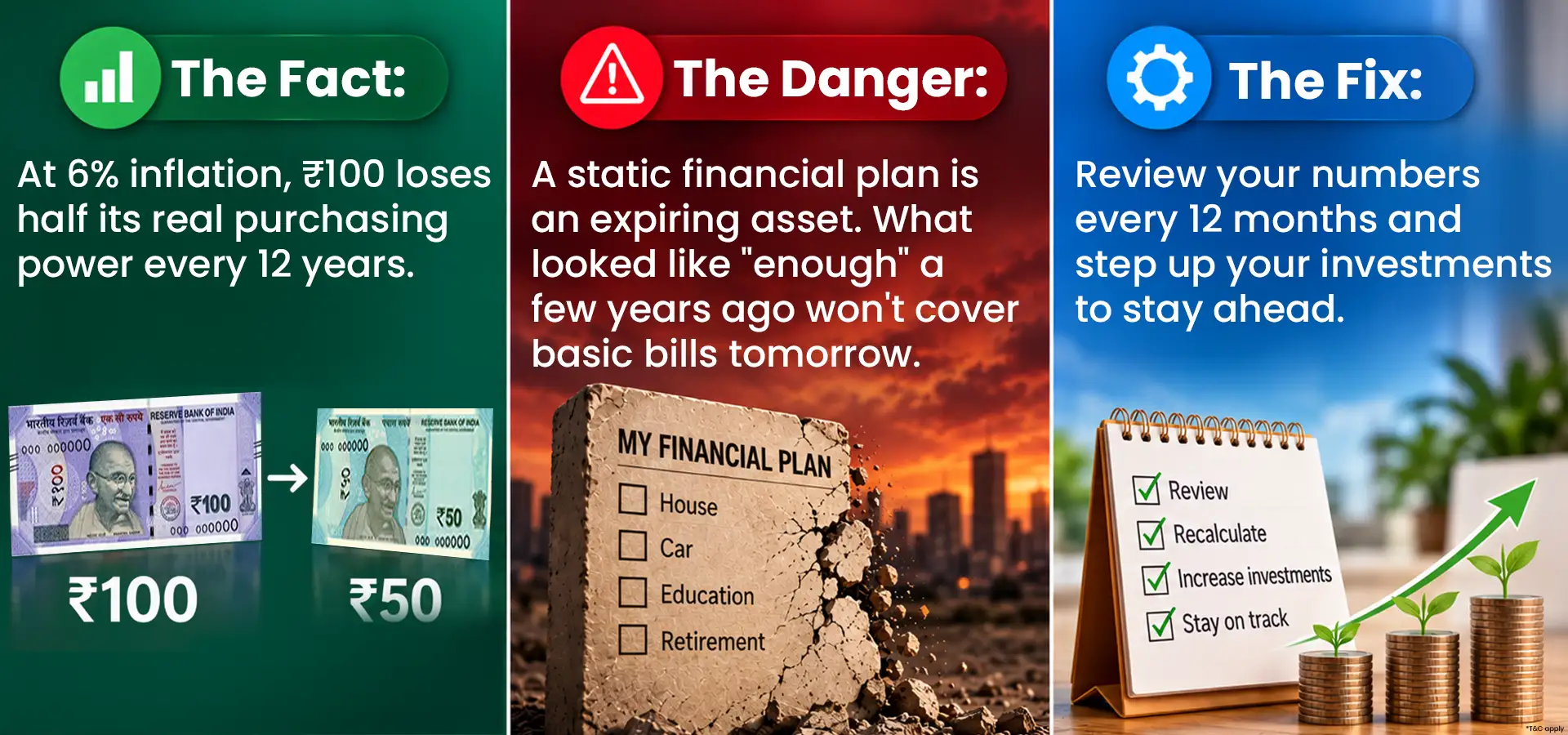 Source: Reserve Bank of India (RBI) – Financial Education / Investor.gov – Purchasing Power & Inflation.
Source: Calculation based on 6% annual inflation; RBI on inflation and purchasing power.
Investor.gov does recommend reviewing investments/asset allocation every 6–12 months.
Step 1: Schedule a time each year to sit down and analyze your retirement plan. A good time to do this is while you are reviewing your annual finances or doing your taxes.
Step 2: Call Finkeda and run your new age, income, and spending data through the team to determine where your plan stands.
Step 3: Compare your estimated corpus for this year with last year’s amount to see if you are ahead or behind.
Step 4: If you’re behind, don’t wait for a significant leap in income to act; bump up your monthly donation inside Finkeda.
Step 5: Instead of just a snapshot of a single year, have an accessible year-by-year log in the app so you can show your progress as a trend line. Makes the whole process feel a lot less intimidating.
It’s a smart practice to assess your retirement plan at least once every year, ideally when you complete your yearly financial check-up or file your taxes. Make sure that your monthly payments are still in line with your new aim and look to increase them as your income grows. Keeping this review consistent and using Finkeda to store all your numbers in one location makes the whole process a lot less overwhelming than starting from scratch every time.
Here’s a more extensive breakdown of what each major path often entails if you are weighing your choices.
The Employees’ Provident Fund (EPF) is a straightforward, low-risk system, automatically withdrawn from most employees’ paychecks in the organized sector, and offers regular, guaranteed earnings in the long run. The first pension scheme most paid professionals build up is usually the one they do without even being aware of it, since contributions are deducted automatically.
The Public Provident Fund is a government-backed program with a long lock-in period. It is suitable for conservative savers who desire tax-free guaranteed growth without market exposure. Consider the fund as a supplement to your other growth-oriented options, not your primary retirement investing plan.
The National Pension System is a mix of stock, corporate bonds, and government securities and is hence more growth-oriented than fixed-income options alone. There are also further tax benefits under present laws. Usually you can modify your debt-to-equity ratio; as you get older, it just needs a little more care.
Insurance companies’ pension plans normally comprise a savings component and the choice to transmute a portion of your corpus into a regular annuity income after retirement. This can be useful for individuals who prefer to have a guaranteed monthly payment in their older years, rather than handling withdrawals from a lump sum themselves.
Tracking contributions to all four in Finkeda means you don’t have to rely on recollection or fragmented statements to know exactly where your retirement funds stand at any given point. And if you ever want a second opinion, you can always call Finkeda yourself.
It’s not necessary to start with the ideal retirement plan. It demands a beginning, consistency, and flexibility in the face of life’s unavoidable turns. By starting early, setting attainable goals, diversifying across pension schemes, automating contributions, and reviewing your plan annually, you can address almost everything that is crucial, whether you are just starting to investigate retirement savings plans or trying to improve an existing plan. Keeping track of every step of the journey thru the most crucial years will be much simpler if you have Finkeda with you, whether via the app or a quick call to the team.
As early as possible, ideally the moment you start earning a regular income. Even small contributions in your twenties benefit enormously from decades of compounding, so the earlier you begin, the less pressure you will feel later. Calling Finkeda for a quick projection can show you how much those early years actually help you.
This depends on your current age, expected retirement age, and desired lifestyle after retirement, but a common starting point is saving around 15 to 20 percent of your monthly income. Calling Finkeda with your specific numbers gives a far more accurate figure than any general rule.
There is no one single best option for everyone. Depending on your risk appetite, a good mix is usually a combination of Employes Provident Fund or Public Provident Fund for stability, National Pension System for growth and a pension plan for guaranteed income later on. If you combine all of these together in Finkeda, it’s easier to see how the mix is actually performing as a whole.
The most frequent mistakes are starting too late, underestimating future expenses, putting all savings into one scheme, skipping contributions in hard months, and forgetting to increase the savings rate as income increases. You can avoid most of these mistakes by consistently through digital portfolio tools and consulting a certified Finkeda financial advisor. While Finkeda Support is available to assist with any additional queries.
Include some growth-oriented options like equity-linked pension schemes alongside your fixed income investments, since purely fixed return options often struggle to keep pace with rising costs over a twenty- or thirty-year horizon. Reviewing and adjusting your plan every year, and calling Finkeda to check your numbers against current inflation assumptions, also helps you stay ahead of inflation rather than catching up to it later.
Note: The 15–20% figure is a general starting guideline and may not be suitable for everyone. The appropriate amount depends on individual circumstances and retirement goals.
Disclaimer: This article has been put together to give readers a general sense of how retirement planning works and is meant to be read as a starting point for your thinking rather than a final word on the subject. The numbers and examples used, including the corpus figures in the tables above, simply help illustrate an idea and may not reflect what any individual actually experiences, since real outcomes tend to depend on various factors over time. As with most things related to money, it is always a good idea to go through the relevant scheme details on your own and have a conversation with someone suitably qualified before making any decisions that matter to you.
This blog is intended solely for educational and informational purposes. Content reflects data at time of publication and may not accurately reflect current premiums, terms, or regulations. Readers are encouraged to confirm the accuracy and relevance of the data before making any significant decisions.
Share :
Like:
0